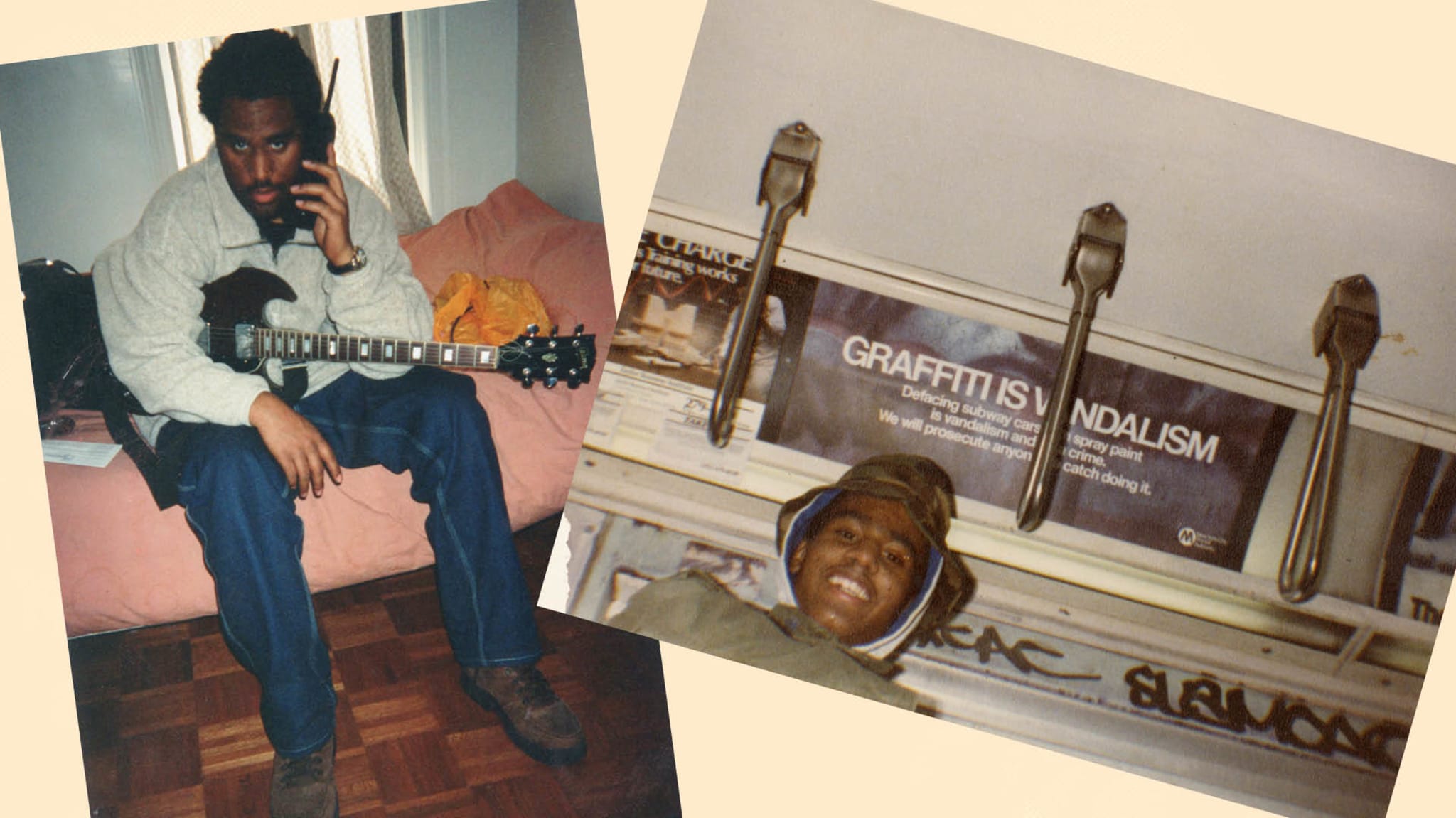
Sacha Jenkins, also known as the graffiti writer SHR-1 and the poison-pen wielder Count Chocula, passed away on May 23, 2025, at age 53. We’ll attempt to grapple with his intangible legacy in a moment, but let’s start with the physical body of work he left behind.
Sacha produced the zine Graphic Scenes and X-Plicit Language in the late ’80s as a high school student, paid for with around $900 in seed money he was able to finagle from his mom. He started rap’s first newspaper, Beatdown, as a self-funded endeavor with childhood friend Haji Akhigbade. He co-founded the amorphous culture media outlet, ego trip—started with $10,000 in seed money from the legendary graf photographer and director of Style Wars, Henry Chalfant—which produced 13 issues over four years, along with a rap compilation, two books, a mini-series, and two television shows. He was the music editor of VIBE magazine for three years. He performed as a bassist in a rap collective, in two hardcore bands with rap influences, and in a rap band with hardcore influences. He wrote all or portions of eight books apart from ego trip, most about graffiti but one about metal and another an autobiography with Eminem. He curated three museum exhibits. He wrote and produced an off-Broadway play starring the Beatnuts and directed a stage show for Prince Paul. He served as the editorial director and chief creative officer of Mass Appeal. If iMDB is to be trusted, he directed 13 films and/or TV series.
This resume does not account for the dozens of unreleased or unmade projects that he wanted to tell on the page or the screen, and the concepts he wanted to try had he gotten even a little more time. But these artifacts do a decent job at capturing Sacha’s life, spent madly in love with all modes of artistic expression, representing the intellectually curious diversity of New York City and its many brilliant, restless, passionate people and subcultures. They express Sacha Jenkins’ ravenous interest in everything.
He was born in Maryland, the product of artists—his mother a Haitian painter, his father a Black filmmaker and TV producer from Philly who helped launch Sesame Street and directed the lost Black indie classic, Cane River. His parents split when he was seven and he ended up with his mother in Astoria, where she would call the cops on the guys loudly playing their records outside Sacha’s childhood bedroom window, unaware that those guys were two DJs who called themselves The Disco Twins, and what they were playing was the beginnings of hip-hop, and that Sacha was perched in the exact right place at the exact right moment in time, as he so often would be. In the NYC public school system of the ’80s—a petri dish for cross-pollinated greatness—he fell for hip-hop culture early and hard as a graf writer, spraying tunnels and cars. And as he was scratch bombing Ed Koch’s New York, he was skating, he was taking photos, he was writing, he was dressing oddly, he was sweating on the rich white kids who drove from Connecticut to mosh it out and slum, who couldn’t figure out what this large, pockmarked Black man was doing at “their” hardcore shows in Manhattan’s southeastern corridor. But as would be the case in all things, he was drawn to exegesis as much—if not more than—praxis.
Before the internet and social media helped us realize how small the world could be for a gifted, savvy networker and operator, Sacha had transformed the city’s junior highs and park jams and headshops and boutiques and clubs into his salon. He had an impossible to fathom web of social connections bonding him to the brothers of famous actresses and network executives and beat makers and punk legends he’d hung out with and got in fights with and stolen cans of spray paint with. When Sacha died, his William Cullen Bryant high school classmate Elliott Wilson wrote about their early days and the city Sacha had remade into a cafeteria at lunch. “His personal network was extensive. We’d sip 40 ozs of malt liquor and walk through the streets of New York together, and it felt like he knew everyone who was cool and in the scene. Sacha was the best talker and the best listener,” Wilson wrote. He went to the same middle school in Queens as Nas, who describes Sacha as “a big brother.” Heroes became patrons and collaborators, legends in multiple games such as Phase 2, Darryl Jennifer, Henry Chalfant, and Prince Paul would inspire him, fund his projects, and make art with him. He was a super producer, a collector of talented artists in all disciplines in need of spiritual guidance and master orchestration, one of Sacha’s many superpowers. “He should’ve been a matchmaker” Prince Paul told me. “He could recognize talent and see this is an interesting person. He had a lot of ideas and his strength was as a producer, Steve Albini or Quincy Jones,” says Sacha’s former partner at ego trip, Brent Rollins.
For all the mediums he’d mine to express himself through, culture journalism was Sacha’s entrée into entertainment, and arguably his most impactful. And among those titles he launched or helped steward, ego trip is his masterwork, the purest expression of his sensibility and talents as a writer, publisher, and conductor. “Whatever you do, you can’t be vague, your lines gotta be sharp,” Sacha said, and at ego trip his lines were never sharper. It was more than a magazine—it was an emergent perspective, a voice, an attitude, and a groundbreaking outlet for rap’s misfit, opinionated, educated nerds.
Ironically, ego trip was great precisely because it was a project devoid of ego. The collective—Sacha, Jeff “Chairman” Mao, Elliott Wilson, Gabe Alvarez, and Brent Rollins—would write in an office that moved nomadically from year to year, through Queens and later Manhattan, working in group sessions that treated the word processor like a blunt, or a mic. “It was like we were in a band or a graffiti crew that creates in collaboration—they would paint stuff, and everyone has their own style, and then each would go over the last person’s shit,” Rollins says. “When ego trip would write these editorials or articles, it was jamming.” It is indicative of Sacha’s collaborative spirit. He was a team player comfortable coming off the bench. The rapper and occasional media member Open Mike Eagle was one of Sacha’s many mentees and was constantly struck by his humility. “I’ve never known somebody in hip-hop as boisterous and thoughtful, as opinionated and as great a communicator as Sacha, who was so comfortable playing the background, who was more comfortable not being a star,” Mike says.
When you read it now, you can sense that ego trip wasn’t a project its authors merely wanted to work on—it was work they had to do, a perspective and sensibility they needed to transmit to the world. “We brought the barbershop to it,” Wilson once said of the outlet’s contribution to rap media. Mao once explained the frustrated inspiration that animated their project: “It was checking out what other [magazines] were doing and seeing how seriously they took themselves,” Mao said. “We were always ready to clown the competition. We had a chip on our shoulder, trying to outsmart and outwit and outwork everybody else. We'd read stuff in The Source and Vibe and say, ‘Oh, this is terrible.’ And, ironically enough, we started writing for those magazines as well.”
ego trip was the rap magazine as extra credit, done after work, at night once the team finished writing and editing for mainstream hip-hop publications. (Or, as Rollins referred to those gigs: “Moonlighting.”) They used aliases because they didn’t want to get in trouble at their day jobs, a cover Fat Joe fondly remembers blowing for Sacha. “I was riding with Big Pun in the Benz in Manhattan and I saw Sacha and called out ‘Yo Count Chocula!’ He turned around, responding to the name, and I looked at him, and he looked at me like, ‘Damn, you got me,’” Joe remembers fondly. “We just kept that between us forever.”
In the ’90s, rap was largely serious business—not only in terms of the music, as well as how rap was covered, whether it was writers who felt a responsibility to fight for rap’s validity as an artform, or bad-faith, clueless critics who saw it as dangerous noise produced by the lost generation of a failed state. But rap had enough champions and cheerleaders and tone-deaf enemies—it needed tough love, voices of dissent. The industry was ripe to be taken down a peg, by witty, acerbic assholes who loved the culture, who were fluent in its language and well-schooled in its customs, but would shoot spitballs at it from the back of the bus.
Humor was ego trip’s superpower, the quality that made it stand out, and drew everyone I spoke to for this memorial to the magazine in the first place. It was an exact and perfect translation of Sacha’s dry, slick, sarcastic perspective and sensibility to the page. “He was very tongue-in-cheek, always taking the piss out of things. He had a very ’90s, DIY, goofy spirit,” says Rollins, and so did the magazine. “If you have no sense of humor, I can’t fuck with you,” Sacha once told his former intern, Noah Callahan-Bever, and it was that sense of humor, the laughter the magazine provoked from all of us that drew Noah to the ego trip offices, for a summer internship that would extend ego trip’s influence into the next century and start what would become a coaching tree of writers, thinkers, critics, and executives that continue to shape the tenor and direction of the culture and how its covered.
ego trip didn’t have a circulation that fucked with The Source or VIBE or XXL, but it was a Velvet Underground proposition in that every reader they had went on to start some form of rap publication. One of those readers was Jeff Weiss, once a fledgling West Coast culture writer who would launch Passion of the Weiss, the still current (and arguably last standing) daily independent rap blog he’s published for nearly two decades. “ego trip invented a sensibility that had been alien to rap journalism, a reverent, loving disrespect. It represented everything I still strive to be,” Weiss says. Mano Sundaresan is now the editor of Pitchfork, but once he was a burnt-out freelancer seeking direction to start his own blog, which would become No Bells. He found it in The Book of Rap Lists. (Since Sacha passed, both the magazine issues and books have gone from expensive rap collectors’ items to priceless grail-like artifacts running hundreds if not thousands of dollars on Amazon or eBay, if you can find them at all.) “What inspired me was the idea that list-making can be a form of criticism, one that says as much about the maker as it does about the actual art or artists being ranked. I was flipping through those lists and cracking up and having so much fun, and it rewired my brain. ego trip shit was giving me life, convinced me there could be another way,” Mano says.
What inspired many of us was ego trip’s authoritative voice, the inherent sense that you were reading a document both by and for lovers of hip-hop, that understood it intimately. “They were embedded in the culture where it was like inextricable, not hating just being smart and critical, that managed to walk the line in ways that I think most try and fail. They were locals, they thought and spoke rap. They were products of that world, and that time and I think probably they were the best representation of it, they took hip-hop seriously but were never self-serious,” Weiss says. It was apparent to Open Mike Eagle as well. “I was blown away by how self-aware it was. Blown away how funny it was and how it felt just like when me and my homies used to sit around and talk about rap. They were writers who were obviously in the culture of hip hop and loved it, loved the craft, the history,” Mike says.
“There are voices in my head telling me to do things, and I try them, and a lot of times I fail. That’s my secret. If you’re afraid to fail you’re never going to win, ever,” Sacha said. And this wandering became more pronounced as he moved to the stage in life when many settle into their professional groove and dedicated purpose. With his many obsessions and constantly shifting gaze, Sacha’s career was a constant cycle of finding a creative peak with a group of fellow creatives, then blowing it up and miraculously bouncing back. But with each fearless experiment, grounded by his history and experience doing a little of everything at ego trip, his mature period contained far more Ws than Ls.
Sacha wrote ego trip’s first cover story, featuring Nas, and in the middle of the interview there’s an action description I think about a lot while working on profiles. Sacha asks a question that elicits an emotional response from his outerborough brethren, that Sacha relates to the reader through a vivid mid-interview parenthetical: “(Nas bangs the conference room table with passion, creating interesting harmonics between flesh, wood and glass courtesy of Snapple)”. That snippet of writing explains why Sacha was a born filmmaker, an autodidact with a cinematic eye, who discovered he was a filmmaker in real time, which surprised exactly no one who grew up reading his work.
For those disappointed ego trip didn’t get the long run the magazine deserved, seek out Sacha’s films, which were his main preoccupation following the dissolution of the corporeal collective. He was ego trip’s keeper of the horn of fire, a flame that burned throughout his documentary work, lovingly chronicling the official and unofficial elements of hip-hop, how it transformed fashion and language, and his masterpiece, a four-hour profile of rap’s greatest group.
The key to the success of Sacha’s Wu-Tang profile, Of Mics & Men, is the Clan’s unqualified buy-in, success Sacha would have again and again with legendary sources from all walks of life, from Ta-Nehisi Coates, to Pharrell, to Andre Leon Talley, to Kanye West. “I thought it was like the definitive Wu-Tang documentary. The number one most essential thing you need to make a great documentary is getting someone to open up to you, and it was clear that Wu trusted Sacha and saw him as a peer, not as some sycophant. There are very few people on Earth that have that kind of credibility,” Jeff Weiss says. What I like to think is it’s an indication of his talent as a journalist and documentarian, the result of Sacha approaching his work authentically, without pretension or cynicism. He met his subjects where they were. Of Mics & Men is a rap doc that transcends the tenants of that often staid, formulaic, artist dictated genre.
Of course his music projects, from hardcore outfits the 1865 and the Wilding Incident, to White Mandingos with Darryl Jennifer and Murs, to the tragically finished but still unreleased SuperBlack! project with J-Zone and Prince Paul, are all perfectly bizarre permutations of seemingly incoherent artists that meld on the track. It’s genre warping work that is irreverent and satirical and searing in equal measures and always oriented around nuanced, funny, sad and painful conversations concerning race. Sacha met Prince Paul through The White Rapper Show, and the two remained friends and spiritually aligned frequent collaborators through the rest of his life, working on so many projects Paul literally can’t remember them all. “Sacha was the catalyst. He called everyone and said he wanted to do a band. So I said, 'Sounds good.' I always liked J-Zone. [Sacha] didn’t have the full concept figured out but we built it out as we talked. He just wanted to put us three together.” Paul says of a familiar trajectory with Sacha’s many late creative projects, pulling together disparate threads to make something profound. Open Mike Eagle loved Sacha’s music, and regretted that it was less heralded than his other creative endeavors. “I wish that he had been in a position to put his music a little more forward, to put that side of himself into the world a little more. To make culture rather than “just” report it.” Mike says.
“ego trip was about the five of us exploring our identities and where we fit into America,” Sacha said, and this was the core of all of his work. When he was making films about subjects as diverse as Louis Armstrong, Rick James, and Biz Markie, Sacha understood culture as an expression of identity, which was his master thesis and the reason why he was such a brilliant arbiter of race. He could clearly see the lines that connected race to everything in American life. He often said “Hip hop is a reaction to its environment”, he saw the throughline from the blues through jazz to hip-hop, that these are the reflections, the recurring narratives of the Black American experience existing side by side on a continuum of never-ending struggle. “He would use race to poke at people and push their buttons to get a sense for where they stood. And for the most part he would work through discomfort to assure them he wasn’t some scary Black man, and that was his power. It didn’t work for everyone but when it worked, it really worked,” Brent Rollins says.
Mano Sundaresan still sees the fingerprints of ego trip’s influence everywhere (including at the outlet where you're reading this), even if he feels that the heart, the ethos behind the delivery system they pioneered has lost its way. “The list has become the language of music journalism in a lot of ways, but it's for all the wrong reasons. It's peg-centric, SEO, click-farming bullshit half the time, and we all do it. I just feel like the distinction here is that Rap Lists, in its esoteric specificity, reflects a real love for the medium of the list and it doesn't feel cynical, it feels like hanging out with your friends, and a bong,” Mano says.
When Sacha died, one of Sacha’s actual friends and partners, Brent Rollins said, “It’s like losing a brother, and families argue, but it’s like losing a brother who raised me.” Open Mike Eagle tells the story of first meeting Sacha, which contains much of his magic. Sacha had come to Los Angeles to interview for a position as a showrunner the network Mike was working with ultimately couldn’t afford, for a show he wanted to create, but the two kindred spirits made an instant connection over shared values.
“Our mission statement was destroying Black American culture as a monolith … to destroy the idea that Black entertainment was just one thing, and unsurprisingly, Sacha understood right away, knew how to execute the vision better than we did.” Sacha was always great at first impressions, and he made one on Mike. Sacha would serve as a sounding board and advisor to the rapper for the rest of his life. “I met Sacha at this later point in his career, and the man I knew was so mature and introspective.” Mike says, a characterization many of Sacha’s collaborators in his younger days might be shocked to hear, but it appears he found stability in his family, and peace in his success.
Of course he was still, and always would fundamentally be Sacha. Mike recalls, “We were wrapping up the meeting in front of these network executives, and after an hour of being smooth and brilliant, Sacha shakes everyone’s hands, and he smiles, and looks at me, and says, ‘Now let’s take these white people’s money.’