On December 6, 1999, just 25 days before the new millennium, the Recording Industry Association of America filed a lawsuit against file-sharing platform Napster for copyright infringement.
Now, 25 years later, the effects of the case—which Napster ultimately lost, shutting down in 2001 and clearing the way for streaming—linger. Listener expectations shifted dramatically thanks to the cheap ubiquity of the mp3 and file sharing, creating an insatiable appetite for more music. Songs are now shorter, artists are more plentiful and accessible, there are fewer stars and traditional gatekeepers are nowhere to be found. Eras—the mixtape era, the blog era, the streaming era, the SoundCloud era—are now defined more by how the music is delivered than by the music itself.
This shift benefited rappers in particular—artists who not only had intimate, direct relationships with their fans, but have also operated on low budgets with DIY setups from day one.
Artists from other genres started to take note. So shit flowed: more music was released during the first quarter of the century than at any other point in history. And a lot of it, to put it bluntly, fucking bangs. We got the debuts of Kanye West, Kendrick Lamar, Frank Ocean, Rihanna, Bad Bunny, and Drake—transformative figures who reshaped the musical landscape. When it comes to quality, recorded music remains the premier form of artistic expression, which makes narrowing the greatest albums of the last quarter-century into a single list of 50 an impossible task. Which, of course, is exactly why we did it.
A couple of ground rules: When we say “Best,” we’re factoring in quality, impact at the time, and the album’s long-tail influence. This is a list of albums, which means we mostly left out traditional mixtapes, except ones that included entirely original music. And yes, we know the 21st century technically starts in 2001, but we’re counting 2000, so shout out OutKast, D’Angelo and Ghostface. We also decided not to impose limits, so some artists appear multiple times in the top 50—and honestly, they should. Does it really make sense to have a list like this with one Ye album? One Kendrick album?
Finally, we considered everything up to the date of publication, although—spoiler alert—nothing released this year made the list.
Now, let’s get to it: here are the 50 best albums of the 21st century.
Shop our Best Albums of the 21st Century Collection
50.Justin Bieber, Purpose (2015)
Label: Def Jam/RBMG/Schoolboy
To be a modern-day pop star is, in some sense, to be constantly groveling.In 2015, Justin Bieber was coming off a series of mild transgressions—a bad breakup, some public outbursts, a commercially ignored R&B album—when he made Purpose.
A self-serious pop record with strong Christian undertones might have seemed like a disaster if not for one savvy artistic decision: embracing the dancehall infused EDM of Skrillex, whose work on “Where Are Ü Now” gave Bieber a new creative direction. It’s a song that, fittingly, melts down rather than builds up. —Dimas Sanfiorenzo
49.Erykah Badu, Mama's Gun (2000)
Label: Motown
The Soulquarians era of the late ‘90s and early 2000s was brief but brilliant.
The Roots, Common, and the late great D’Angelo released records that changed Black music, culture, and time itself. Erykah Badu’s sophomore album is one of those catalysts.
If Baduizm was an introduction to the hotep high priestess (complimentary) from Dallas, Mama’s Gun was a full immersion in her world. And she took us deep; “Bag Lady” exhorted women to unburden themselves from the weight the world saddles them with, “Booty” was sisterly advice wrapped up in a bit of braggadocio and the album’s climax, “Green Eyes” is a 10-minute epic that captures the grief and contradictory feelings of breakups in a way that could only come from intimate experience with them (coincidentally, this was released after her split with her first child’s father, André 3000). —Timmhotep Aku
48.Young Thug, So Much Fun (2019)
Label: YSL/300/Atlantic
After years of experimenting on mixtapes and features, Young Thug’s creative powers reached a peak on So Much Fun. Across the album, Thugger shows off his gifts as a vocal contortionist, flexing his knack for crafting radio-ready earworm hooks and flows on “Hot” and “The London.” Meanwhile, on “Sup Mate” and “Pussy,” his squeaky flows barely sound like words, proving just how fearless Thugger is in his musical eccentricities. So Much Fun is one of those projects where even the title and the cover—made of 803 miniature Young Thugs arranged into a self-portrait—serve as a celebration of his legacy. —Antonio Johri
47.Ariana Grande, Thank u, next (2019)
Label: Republic
You shouldn’t judge a book by its cover, but you can judge an album by its song titles: “fake smile,” “bad idea,” “break up with your girlfriend, I’m bored,” and, of course, “thank u, next.” All signs Ariana wasn’t in the mood to be tussled with.
Released just a couple of months after Sweetener—when she was happily in love with Pete Davidson—thank u, next sees Grande processing the double whammy of that relationship ending and the tragic death of her ex, Mac Miller.
She does it with her typical dedication to pop craftsmanship, now sharpened by a harder exterior. Before the album’s release, Ariana talked about wanting to put out music the way rappers release mixtapes—not driven by rollouts, but more instinctually, guided by whatever she was feeling in the moment. In that sense, thank u, next becomes a true one-of-one album, a moment of rare, dishevelled energy from one of the most pristine pop figures of the 21st century. —Dimas Sanfiorenzo
46.The Diplomats, Diplomatic Immunity (2003)
Label: Island Def Jam/Diplomat/Roc-A-Fella
For a group that holds so much significance in modern NYC history, it often comes as a surprise that Cameron Giles’ rap collective, the Diplomats (affectionately referred to as Dipset), only released two albums.
After introducing the world to Juelz Santana, Jim Jones, and Freekey Zeeky on Cam’s Roc-A-Fella debut, Come Home With Me, the group followed up with Diplomatic Immunity, a collection of chaotic skits and irreverent records over booming soul samples and unrelenting drums.
A hip-hop quartet of the post 9/11 era, Dipset didn’t just talk about women, cash, and drugs, but also was imbued with a sense of hostility and malaise towards the American identity altogether, creating a sound and style that directly confronted the function of patriotism within communities that thrived in the margins—American eagle chain and all. —Shamira Ibrahim
45.Nas, God Son (2002)
Label: Ill Will/Columbia
On April 11, 2002, just a few months after the greatest professional triumph of his career, Nasir Jones lost his mother to breast cancer. These conflicting emotions—exultation and grief—run throughout God’s Son.
Unlike many later albums weighed down by high concepts, God’s Son tones aside some of his more corny Nas-isms. There are no Edward G. Robinson–style “yahh see” raps here. The album intro, “Get Down,” is a triumphant piece of crime storytelling built around a flip of James Brown’s “The Boss,” so poignant that Lord Finesse would be proud. On “Last Real Nigga Alive,” Nas fully embraces ’90s lore, acting as the hood scribe chronicling street wars between the era’s greats.
The album’s final stretch—from the gut-wrenching “Dance,” which features a devastating horn solo from Nas’ father Olu Dara, to the soulful “Heaven”—finds the usually stoic rapper at the most vulnerable of his career. —Dimas Sanfiorenzo
44.Cardi B, Invasion of Privacy (2018)
Label: Atlantic
Cardi B’s debut album is in the pantheon of contemporary New York City classics, cementing the Bronx rapper as a hit-making superstar. “I Like It” is a smash, with Cardi embracing her Latin roots alongside J Balvin and the then-rising Bad Bunny. “Be Careful” delivers an earnest look at her love life and fear of infidelity. And “Bodak Yellow” is such an electric banger that it caused a 217% spike in online searches for Christian Louboutin shoes. —Jordan Rose
43.MF DOOM and Madlib, Madvillainy (2004)
Label: Stones Throw
Metro Boomin and 21 Savage, Hit-Boy and Nas, Freddie Gibbs and Alchemist—shit, everybody and Alchemist—by now we’re all accustomed to, and anticipate, the one rapper-one producer collab album.
And while Madvillainy may not have been the first project to fit this description in hip-hop history, it was the first time a rapper-producer duo was understood as a supergroup. Both DOOM and Madlib each came to the table with their own cult followings after years of feeding the then burgeoning, 12”-driven indie rap market with music that was as forward-thinking and humorous as it was reverent to its boom-bap forebears.
In 2004, Oxnard, CA’s Madlib and Long Island-by-way-of-London’s DOOM were arguably the two most fascinating figures in underground rap. A small group of mutuals, including Complex founding editor Miranda Jane, aka Walasia Shabazz, brought these kindred spirits together after they had expressed mutual admiration and a desire to collaborate.
Madvillainy is trippy, funky, jazzy, and most of all raw, in sharp contrast to the contrivances of major-label rap at the time. The duo set the standard for what was possible when a producer and a rapper decided to lock in with each other. —Timmhotep Aku
42.T.I., Trap Muzik (2003)
Label: Atlantic/Grand Hustle
Before the arrival of Trap Muzik, Tip Harris bet on himself. After the underwhelming sales of his 2001 debut I'm Serious, he negotiated an exit from Arista Records. He then launched Grand Hustle, partnered with Atlantic, and released one of the South’s defining albums. Production came from figures who would dominate 2000s rap: DJ Toomp, Cool & Dre, David Banner, and a young Chicago producer, Kanye West. While the album wasn’t the commercial juggernaut that his next two albums —Urban Legend and King—would become, it helped establish Atlanta’s status as a rising force in rap. —Will Schube
41.Justin Timberlake, FutureSex/LoveSounds (2006)
Label: Jive/Zomba
While Justin Timberlake’s debut solo album, Justified, was an enjoyable collaboration with the funky brainchild of the Neptunes, his follow up, FutureSex/LoveSounds was a heady adventure into the futuristic soundscape developed by Timbaland and Danja.
The album’s electronic sheen drips with eroticism in club tracks like “SexyBack” and “Summer Love.” Its rich palette of percussion lends a retro edge to ballads such as “Until the End of Time,” while Timberlake reins in his boy-band falsetto to deliver a more mature, rock-tinged vocal performance.
The album may not have exactly been Thriller 2006, as Timberlake and Timberland once named the secret project, but it established the former NYSNC lead as a heavyweight in pop experimentation. —Shamira Ibrahim
40.Amy Winehouse, Back to Black (2006)
Label: Island
When Amy Winehouse’s second, and final, album came out, a who’s who of major musicians toasted its arrival (and the star’s true crossover moment in America): Jay-Z, Mos Def, and Dr. John, among others, attended the exclusive gigs she performed at Joe’s Pub in New York in March 2007.
It’s a queasy record. You know the hook on the Mark Ronson-produced opener and you know it’s true. She didn’t go. A 2008 profile in Rolling Stone explains that in January of that year, after a British tabloid shared a video of the Enfield-born soul singer smoking crack, she did go to rehab. “She didn’t stay long, and she happily tells me she did drugs the whole time,” the journalist Claire Hoffman reports. There are many remarkable songs on Back to Black and they only become heavier in the full context of her tragedy. The title track and “Love Is a Losing Game” are moving to a degree that goes beyond mere pop music, into a space that’s too grim to stay in for more than a couple minutes. —Ross Scarano
39.Kid Cudi, Man on the Moon: The End of Day (2009)
Label: Dream On/GOOD/Universal Motown
In 2010, the world was waiting for Kid Cudi’s debut album. He already had the classic A Kid Named Cudi tape under his belt and had contributed both melodies and lyrics to 808s & Heartbreak, as well as the scene-stealing “Already Home” hook on Jay-Z’s Blueprint 3.
When the time came to go from “blog-era” stalwart to legit rap star, he cooked up with his small crack team: Plain Pat (what up!), Emile, Dot Da Genius, and Ye, along with secret weapon Jeff Bhasker. Together, they helped Cudi take the leap from supporting character to the main star of his own story.
Man on the Moon: The End of Day was genre-bending piece of art that changed rap forever—or perhaps better described by Kanye West when he told Complex in 2009: “Me and Cudi are the originators of the style, kinda like what Alexander McQueen is to fashion; everything else is just Zara and H&M.” On the deep cuts, Cudi weaves in and out of true, candid darkness on “Solo Dolo” while sprinkling in shreds of optimism on “Cudi Zone” and “Up, Up & Away.” And the singles, like “Day ’n’ Nite” and “Pursuit of Happiness,” have aged like a 2000 vintage bottle of Château Lafite Rothschild. —Joe La Puma
38.Juice WRLD, Goodbye & Good Riddance (2018)
Label: Grade A/Interscope
No project better encapsulates the SoundCloud era like Juice WRLD’s Goodbye & Good Riddance. Raw, wounded, and unfiltered, Juice’s superpower was translating his pain into piercing melodies. His influences—Blink-182, Black Sabbath, Gucci Mane—shouldn’t coexist, yet in Juice’s world they fused into something that stuck. GBGR felt like the first time mainstream listeners heard emo-rap fully realized, built from the experimentations he, X, Uzi, and Trippie Redd were fine-tuning. Juice emerged as the cleanest songwriter of the pack—unapologetically vulnerable and devastatingly catchy. —Jon Barlas
37.Tyler, The Creator, Call Me If You Get Lost (2021)
Label: Columbia
On the surface, Tyler, the Creator’s 2021 album Call Me If You Get Lost feels like a victory lap, arriving just after his first Grammy. But beneath the bravado, his seventh studio album is really a love letter to a particular era of rap, the early 2000s mixtape, and DJ Drama.
Tyler sheds his IGOR persona, swapping the blonde bob for glinting jewelry and the keys to a Lancia Delta Integrale. His lyrics strike a sweet spot between swagger and sincerity. Tracks like "LUMBERJACK" and "HOT WIND BLOWS" prove he can spar with the best, while "WUSYANAME" and "SWEET / I THOUGHT YOU WANTED TO DANCE” showcase his knack for irresistible, pop-tinged hooks. —Marc “Spidey” Griffin
36.Billie Eilish, When We All Fall Asleep, Where Do We Go? (2019)
Label: Darkroom/Interscope
“I have taken out my Invisalign, and this is the album.”
Is there a better opening line this century? On When We All Fall Asleep, Where Do We Go?, Billie Eilish distilled everything she’d learned from SoundCloud rap into a self-made pop persona: precocious, subversive, goth.. For a 17-year-old, the album is a stunning achievement—modern and forward-thinking, yet rooted in tradition. The highlight “When the Party’s Over” shows Billie’s real chops as a vocalist; it’s an old-school jazzy ballad that demonstrates how quickly irreverence can give way to genuine emotion. —Dimas Sanfiorenzo
35.ASAP Rocky, LIVE.LOVE.A$AP (2011)
Label: Polo Grounds/RCA
Make no mistake about it: A$AP Rocky’s debut mixtape LIVE.LOVE.A$AP is one of the defining projects of the 2010s.
With the help of Clams Casino and Ty Beats, the prettiest motherfucker in Harlem introduced a generation to the syrupy sounds of Houston’s chopped and screwed scene, cross-pollinated with New York shit talk and bravado. Whether it’s the immersive “Palace,” the street classic “Peso,” or the speaker-shaking Schoolboy Q collab “Brand New Guy” with Schoolboy Q, this tape is full of classics. A debut like this is a gift and a curse. Some listeners are still yearning for a release from Flacko that lives up to the standard he set back in 2011. —Mike DeStefano
34.Usher, Confessions (2004)
Label: Arista
The blueprint for a contemporary crossover R&B success. An album that used rumor-mongering and extra-textual gossip as fuel well before Lemonade. The apotheosis of a teen star coming into his own as an adult and dominating the charts without watering down his sound. A demonstration of the power of locking in with a trusted producer to realize a cohesive vision, producing single after single. Despite selling more than 10 million copies, Usher’s Confessions is almost underrated at this point. It’s a feat that could not be repeated in the streaming era; it’s hard to convey its level of significance and achievement in light of what the music industry has become. A true unifying force, Usher was monoculture and it felt incredible. —Ross Scarano
33.Kendrick Lamar, To Pimp A Butterfly (2015)
Label: TDE/Aftermath/Interscope
Kendrick Lamar has consistently created meaningful and beautifully produced albums. On To Pimp a Butterfly, however, he achieved something different: he connected social issues and his own internal struggles—with fame, identity, trauma, and responsibility—to historic injustices. These are the themes, but there is also the music. To Pimp a Butterfly is a spiraling blend of ambitious jazz, funk, and soul, reinforced by Kendrick’s knotty, self-aware style of rap. The single “Alright,” produced by Pharrell and Sounwave, transcended even the album itself. Its upbeat sound became a protest anthem during the Black Lives Matter movement, propelled by one line:“We gon’ be alright.” —Breeana Walker
32.Clipse, Hell Hath No Fury (2006)
Label: Re-Up Gang/Star Trak/Jive/Zomba
It’s hard to believe now—given the GQ Men of the Year, multiple Grammy nods, and general hubbub surrounding Let God Sort Em Out—but there was a time when Clipse was overlooked. When Arista folded after the release of the group’s debut Lord Willin’, the Thonton brothers were sucked into Jive Records, and the story goes that the label’s commercial-leaning directives were antithetical to the sounds Clipse were making on Hell Hath No Fury.
The album remains the crowning jewel of one of rap’s most formidable discographies. Packed with standout singles, essential deep cuts, and some of the best cocaine raps ever recorded, HHNF marked the start of Pusha T and Malice’s reign—a story that is only now entering its next act. —Will Schube
31.Lana Del Rey, Born to Die (2012)
Label: Stranger/Interscope/Polydor
Lana Del Rey debut as Lana Del Rey was not well received by the masses upon its release. Between her infamous Saturday Night Liveperformance and a devoted teenage fanbase, misogyny played a large role in the reluctance to recognize Del Rey as a revolutionary voice in pop music. But time heals pop culture wounds, and Born to Die has held up remarkably well.
Exploring themes melancholy and taboo, Del Rey’s brooding, sultry vision flipped the pop landscape upside down amid the maximalist offerings of artists like Lady Gaga and Katy Perry. Continuing the lineage of legends such as Alanis Morissette and Fiona Apple, Del Rey reminded the mainstream that there’s more to pop than glossy hooks and spectacle. —Jade Gomez
30.D'Angelo, Voodoo (2000)
Label: Virgin/Cheeba Sound
I recently asked friends what the greatest “Sunday album” ever made was. Voodoo won handily, a result that feels both right and somehow inadequate. Because what does a Sunday album mean? I would describe it as comfort above all else: a tracklist you know by heart. You put it on while vacuuming the rug, doing the dishes, wiping down the fridge, or throwing a roast in a low-temp oven. You have gentle sex with your partner. It’s music that puts you in good hands.
This doesn’t account for the subversive genius of D’Angelo and Questlove cooked up in 2000. And yet it is undeniably comforting—no one has ever put as much thought and effort into an album that plays so easily, which is what makes it the first true masterpiece of this millennium. —Abe Beame
29.J. Cole, 2014 Forest Hills Drive (2014)
Label: ByStorm/Columbia/Dreamville/Roc Nation
2014 Forest Hills Drive marked the moment J. Cole officially joined rap’s Big 3. The album captures every facet of his life and persona up to that point. On “January 28th,” Cole flexes his bravado and hunger for the crown. “GOMD” showcases his skepticism about Hollywood and fame, while “Love Yourz” offers a sobering reminder that no matter how high you climb, you need someone to keep you grounded.
The effort paid off, resulting in a six-time platinum album that stands as his best project and one of the most significant rap albums of the 21st century. —Jordan Rose
28.Jay-Z, The Black Album (2003)
Label: Roc-A-Fella/Def Jam
If Hov had actually intended to retire from rap, The Black Album would have been his version of Michael Jordan’s Game 6 jumper over Byron Russell.
Pushing off tracks from Just Blaze, Kanye West, Pharrell, and Rick Rubin, Jay alchemized raw feelings and universal truths into pure rap songs that are as visceral as they are refined.
On “Lucifer,” he turns thoughts of vengeance into spiritual warfare, with Kanye Wests’s yelping Max Pompeo sample transforming Hov’s words into a thrilling exorcism. Meanwhile, “Moment of Clarity” sees Jay get therapeutic for a track that more than lives up to its title. Here, Hovito’s stanzas are as quippily defiant and incisive as ever, and his phonetic control matches the concision. It’s apex rapping that somehow doesn’t get consumed by the towering anthemic structures they belong to.
“Public Service Announcement” is a mission statements grafted onto stadium-worthy organs. Speaking of stadium status, “What More Can I Say” is basically “U Don’t Know” and “The Ruler’s Back” put together, with its gladiatorial horns playing out like an epic, where the good guy just won. —Peter A. Berry
27.Kanye West, Graduation (2007)
Label: Roc-A-Fella/Def Jam
The “But he made Graduation!” people might have a point.
While composing musical masterpieces will never absolve an artist of the kinds of behavior we’ve seen from Ye, his third studio album is, undeniably, excellent. The hit singles—“Flashing Lights,” “Can’t Tell Me Nothing,” “Stronger,” and “Good Life”—were further proof that Kanye had not only mastered making great hip-hop but also pop songwriting and production.
The hooks were catchy, the bars were clever, and the beats ranged from bop (“Good Life”) to straight up bangers (“Barry Bonds”) This was the first glimpse of the refined maximalism we’d see perfected on My Beautiful Dark Twisted Fantasy.
This was also a turning point in culture; a Revenge-of-the-Nerds moment when the bookish, artsy and less threatening element of hip-hop supplanted the streets as rap’s dominant force. Ye’s chart showdown with 50 Cent exemplified this vibe shift and when the smoke cleared and Kanye West was hip-hop’s new center of gravity. —Timmhotep Aku
26.Lil Wayne, Tha Carter II (2005)
Label: Cash Money/Young Money/Universal
In many ways, The Carter II marks the true start of Lil Wayne’s journey to GOAT status. Possessing an innate command of both the English language and flow, Wayne pushed his stream-of-consciousness raps beyond the distinct New Orleans bounce production of Mannie Fresh. An extended production palette helped: his omnivorous approach works across styles, from rap-rock on “Best Rapper Alive” to soulful funk on “Shooter” with Robin Thicke, and even to the more East Coast, chipmunk-sample sound of “The Mobb.” Wayne proved not only that he had matured as an artist but that he belonged among the elite. —Jade Gomez
25.Jeezy, Let’s Get It: Thug Motivation 101 (2005)
Label: Island Def Jam/Def Jam/Sho'nuff/Corporate Thugz
If T.I. brought swagger and suave to trap music, Jeezy turned it into a boxing match. His voice sounded like what happens when someone drinks a smoothie full of gravel. The production? Horns, horns, and more horns, pitched down and tinny, busting through a wall like a marching band who were given access to the pregame creatine. Thug Motivation is the official music of moving companies and weightlifters. And yet, these are stories of success. Jeezy does not want you to quit. He’s Tony Robbins for gangsters. This is music with universal appeal. Hell, “Standing Ovation” has become the official theme music for one of the most popular golf podcasts in the world. Thug Motivation is a 19 song adrenaline shot, with a few moments of pure hedonism dosed out for good fun. —Will Schube
24.Bad Bunny, Un Verano Sin Ti (2022)
Label: Rimas
Un Verano Sin Ti was Benito’s first step toward making a more politically and emotionally charged album dedicated to his homeland, Puerto Rico. “El Apagón” addresses the island’s colonial legacy and the blackouts that followed, while “Andrea” honors a victim of femicide. Musically, Bad Bunny leans into local sounds, from the merengue-infused “Después de la Playa” to the dembow pulse of the smash hit “Tití Me Preguntó.”
Rather than borrowing Atlanta trap elements or conforming to Latin pop conventions, he embraces the full spectrum of the island’s musical heritage, collaborating almost exclusively with fellow Puerto Rican artists. In 2022, Bad Bunny became a global superstar. Ironically, all it took was moving closer to home. —Antonio Johri
23.Travis Scott, Astroworld (2018)
Label: Cactus Jack/Grand Hustle/Epic
On Astroworld, Travis Scott somehow secures a Frank Ocean appearance, gets Drake to deliver one of his best guest verses ever, and brings in Stevie Wonder to play harmonica over James Blake’s vocals. Not too shabby.
Travis’ third studio album was the cultural moment he had been building toward. It is the album where he mastered his version of psychedelic trap, carried by ear-candy reverb and woozy flows. What was even more impressive was how each featured artist, no matter how big, fit seamlessly into Travis’s world. He’s the curator, which means if he can’t do it himself, he calls on the right guest to execute the idea. —Antonio Johri
22.XXXTentacion, ? (2018)
Label: Bad Vibes Forever/Empire
Fans often point to 17 as XXXTENTACION’s magnum opus, the wounded, lo-fi diary that made him the face of SoundCloud rap. But ? proved the controversial Florida phenom wasn’t a flash-in-the-pan. Where 17 thrived on emotional rawness, ? was larger than anything X had released before. It sharpened the edges of his early work and channeled his volatility into hits. X was a genre-bender. Between confessional emo-rap, soothing R&B, moshing punk, acoustic demos, and even an attempt at reggaeton (“i don’t even speak spanish lol”), no two songs sound the same on ?. —Jon Barlas
21.Jay-Z & Kanye, Watch the Throne (2011)
Label: Def Jam/Roc Nation/Roc-A-Fella
All things considered, Watch The Throne should never have worked. Two of the biggest artists in the world—one at the peak of his creative powers, the other already hall-of-fame bound and did it all without a pen—combined with sky-high expectations and a fiercely competitive rap landscape don’t exactly sound like a recipe for success.
Yet Kanye and Jay-Z pulled it off, creating one of the greatest collaborative rap albums of all time. They balanced their energy and egos while delivering everything fans wanted. Even better, they split the workload: Ye dominates “No Church in the Wild,” Hov takes control on “Otis,” and together they craft a generational rap stadium anthem with “Niggas in Paris.” —Jordan Rose
20.Drake, Nothing Was the Same (2013)
Label: OVO/Young Money/Cash Money/Republic
If Take Care was the ultimate expression of Drake’s melodic musings on love and loss, his third LP was his anthem-maker. Songs like “Started From the Bottom,” “Worst Behavior,” and “All Me” find Drake mastering the art of energetic hits, signaling his emergence as a headliner.
That emergence came with a new bravado, audible on tracks like “Pound Cake,” where he raps, “Fuck all that ‘happy to be here’ shit that they want me on / I’m the big homie, they still be tryna lil bro me, dog.” Nothing Was the Same is the signal flare marking that Drake had finally arrived, and the rap game has been different ever since. —Jordan Rose
19.Eminem, The Eminem Show (2002)
Label: Shady Aftermath/Interscope/WEB
Depending on how you look at it, The Eminem Show is the last of a three-peat that either reinforced or established Eminem’s status as the best rapper alive.
For this one, Em fused his nihilistic rhymes with bigger sonic structures and even grander ideas. “White America” is a tense skewering of rap double standards, with the flaring guitar making it an example of apex rap-rock. “Sing for the Moment” is an ethnographic breakdown of rap consumption and the conflicting responsibilities of superstardom. Em also gives room to flex his vocals—or lack thereof.
Even if he lamented not being able to sing, tracks like “Hailie’s Song” stand as the most affecting of his career; his wounded croaks and the dreary self-produced soundscape feel like the kind of heartbreak you feel rather than simply hear. The LP is Em at his defiant best. Whether you wanted to see him on top of the charts or the FBI’s Most Wanted List, you had no choice but to admit that we were in the middle of The Eminem Show. —Peter A. Berry
18.Ghostface Killah, Supreme Clientele (2000)
Label: Epic/Sony/Razor Sharp
Iron Man, Ghostface's first offering, was a great Wu solo debut, but any true fan will tell you that Supreme Clientele is the definitive album.
Featuring stream-of-consciousness verses that were as vivid in detail as they were abstract in their associations (“Mighty Healthy”), heartfelt descriptions of street life complete with the tragedy (Ghost’s “Impossible” verse tacked on to “Saturday Nite”) and comedy (“Woodrow the Basebead”) that come with it, this album is Ghost in all his boisterous, emotive, storytelling, non sequitur glory.
And then there’s the production. RZA may have contributed to only four of the album’s 16 tracks, but if anyone was skeptical about a Wu-Tang album that didn’t feature the majority of Abbott-produced songs, Supreme Clientele silenced them. A hodgepodge of producers—such as Bad Boy Hitman Carlos “Six July” Broady, Juju of The Beatnuts, Haas G, Allah Mathematics, and Inspectah Deck—proved that capturing the essence of the Wu-Tang sound might require RZA’s oversight, but not his constant presence. —Timmhotep Aku
17.Beyoncé, Lemonade (2016)
Label: Parkwood/Columbia
Over a timeline in which “the album”—the notion of this auteurist complete statement of artist intent—has receded from culture, Beyonce’s work has become more high concept and, more novelistic. Each album flows from start to finish and works within its own milieu. Lemonade is Bey’s Here, My Dear—managed by the best producers and songwriters money can buy, a fierce and perfect act of walking away from Jay-Z’s burning car before recognizing you don’t actually walk away from a once in a generation business partnership (and to his credit, Jay apologized with his own album length act of contrition, the comparatively inferior 4:44). —Abe Beame
16.SZA, SOS (2022)
Label: TDE/RCA
SZA turned pain into a redemption arc on SOS. Five years after her genre-redefining introduction CTRL, the singer-songwriter returned with a project that blurred the lines between pop, folk, alternative, and hip-hop, all while keeping the rise and fall of her emotions as its throughline.
She threatens—albeit sweetly—to end it all over an ex-boyfriend on the soda-shop-inspired ditty “Kill Bill”; tries to shield herself from toxic internet behavior on “Ghost in the Machine”; and gets over a breakup by getting under someone new on the punkish “F2F.” SOS was the era in which SZA finally received her just due, three Grammys, and fearlessly said everything listeners wanted to hear. —Jaelani Turner-Williams
15.Playboi Carti, Whole Lotta Red (2020)
Label: AWGE/Interscope
Like MUSIC, Whole Lotta Red was obsessed over and talked about for years before it finally dropped Christmas, 2020.
But nothing could prepare fans for the hyperactive synthesizers, guttural basslines, and Carti’s rapid raspy flows heard on tracks like “New Tank,” “Stop Breathing,” and “Rockstar Made.” The ingredients of rage rap were scattered across the new generation, but Carti was the one who fused them into one chart-topping, culture-shifting album that ignited an entire underground wave. How many albums can say they birthed a whole new subgenre of rap? Yeat, Che, Xaviersobased, OsamaSon, Nettspend, 2hollis—this is the big bang. —Antonio Johri
14.Kanye West, Yeezus (2013)
Label: Def Jam/Roc-A-Fella
In 2013, Kanye’s life and public persona began to unravel. Between his high-profile relationship with Kim Kardashian and headlines spotlighting his mental-health struggles, the rapper seemed to be watching his own kingdom edge toward collapse. Yeezus is the abrasive result of those battles, a record that confronts West’s imperfections and toys with blasphemy—whether by placing himself alongside Jesus, calling himself a God or mixing Billie Holiday’s civil rights song “Strange Fruit” with C-Murder’s street anthem “Down 4 My N's.”
The album captures West at a breaking point, channeling his turmoil through punishing in dustrial production. And in typical West fashion, it closes with the jarringly tender “Bound 2,” leaving listeners to wonder how much of his reflection is confession and how much is performance. —Jade Gomez
13.Future, DS2 (2015)
Label: A1/Freebandz/Epic
There was a year there when Future was really on some Miles Davis shit. After Honest disappointed, he was freewheeling and broken and detached from reality and turned that into some of the best music we’ve ever heard: three classic mixtapes then the album, DS2. People are quick to quote the first lyric from “Thought it Was a Drought”: “I just fucked your bitch in some Gucci flip flops,” but sadly, cruelly, inevitably, it was the next line that in many illuminated what was his greatest muse during this era: “I just took a piss and I seen Codeine coming out/We got purple Actavis, I thought it was a drought.” —Will Schube
12.Kendrick Lamar, good kid, m.A.A.d city (2012)
Label: Interscope/TDE/Aftermath
good kid m.A.A.d city is a novel as much as it is a rap album, a coming-of-age narrative with Dickensian ambition, the sort of swing for the fences that the internet, our pea brains, TikTok, playlisting, and unhinged major label practices have all but eliminated from the world.
The year 2012 was a different time in many different ways, and it was the true beginning of Kendrick’s reign. The album begins with a story of love, lust, and gang-ties, and how the three are often in direct contradiction with each other; good kid is at its best when Kendrick struggles with the way he feels and the way those feelings manifest as actively hostile to his family, friends, and community. Where does loyalty lie? When he’s not asking or being told, he’s having some fun rapping his literal ass off: This album’s got radio singles that never grow saccharine, g-funk throwbacks, neo-soul mediations, and even a juicy collaboration with the rapper who would eventually become enemy No. 1. —Will Schube
11.OutKast, Stankonia (2000)
Label: LaFace Records
By 2000, OutKast had made it clear they were on some experimental shit. Then they got weirder. Stankonia sees André 3000 and Big Boi surrender to all their best creative impulses. With its acid-bathed electric guitar and OutKast's frenzied raps, "Gasoline Dream" sounds like exactly that. They return to that manic psychedelia for "B.O.B. (Bombs Over Baghdad)," a track that frames ghetto chaos with political context that only grew more relevant on 9/11 a year later.
The experimentation was fearless, but, somehow, the two Atlanta GOATs were able to pair those elements with their own inimitably quirky, Southern-fried cool. "So Fresh So Clean" is the purest form of Dungeon Family charisma; a nocturnal bop that's sleek, funky, and soulful simultaneously. While "Ms. Jackson" is a distorted Alien transmission about bitter baby mommas and the cruel, inconvenient stain of dying love. —Peter A. Berry
10.The Weeknd, House of Balloons (2011)
Label: XO
If House of Balloons sounds like the most disorienting afterparty you’ve ever been to, it’s probably because that’s exactly the tone The Weeknd wanted to set. As the antithesis of the early-2010s wave of EDM-infused R&B, Abel Tesfaye cut through the noise with boozy, shadowy tracks steeped in carnal nighttime pleasures and morning-after regrets. Drake was an early supporter; The Weeknd’s melancholic sound was a clear reference point for Drizzy’s sophomore album, Take Care. And for Gen Z listeners who missed the Tumblr era of obscure music finds, The Weeknd’s moody production and apathetic delivery were more than enough to ignite his core XO fanbase.
On his debut mixtape, The Weeknd tantalizes and yearns through the smokiness of “What You Need.” On “House of Balloons/Glass Table Girls,” he revels in debauchery that would make Caligula gasp. By “The Party & The After Party,” he’s so consumed by his own insatiable desires that paranoia creeps in. House of Balloons was not only our introduction to The Weeknd but it also redrew the boundaries of what mainstream pop could sound like. —Jaelani Turner-Williams
9.Beyoncé, Beyoncé (2013)
Label: Parkwood/Columbia
It is hard to overstate the impact of Beyoncé’s, and the shockwaves created by her self-titled album are no exception to that.
The idea that one of the biggest pop stars in the world could create an entire album, with a corresponding videos for every track, and release it with zero buildup, anticipation, or fanfare on a Friday night had been unprecedented prior to 2013, a fact that Mrs. Knowles-Carters brags about herself on the “Flawless (Remix):” “Changed the game with that digital drop.”
But more than overhauling the traditional release cycle, Beyoncé served as a potent reintroduction to the Houston songstress as a mother, wife, and lifelong performer, with a catalogue of songs directly reckoning with a lifetime of gendered pressures around image, sexuality, loyalty, and devotion. —Shamira Ibrahim
8.Frank Ocean, Blonde (2016)
Label: Boys Don't Cry
For nearly a decade, Blonde has soundtracked our lives. It’s the project you return to time and time again: after a breakup, a life-changing revelation, a personal reset, or just those quiet nights when you’re trying to make sense of it all. Part of its power comes from how it arrived. After four years of silence, Frank resurfaced with Endless, his Boys Don’t Cry magazine, and then Blonde—all within 24 hours. It’s the kind of moment that’s engrained in your memory, like buying your first pair of Nikes.
Where Endless drifted through ambient fragments of Frank’s emotions, Blonde gave those ideas a place to fully take shape. Every song feels intimate yet warped, like memories replayed through foggy glass. The production is skeletal and spacious, with harmonies bending at the edges of Frank’s voice as he drifts between clarity and dissolution.
On “Solo,” he sounds freer than ever. With “Good Guy” and “Pretty Sweet,” he’s chasing his strangest impulses. And songs like “Ivy,” “White Ferrari,” “Pink + White,” “Self Control,” and “Nights” reassert Frank’s legacy as one of the most important artists of the 2000s. —Jon Barlas
7.Drake, Take Care (2011)
Label: Young Money/Cash Money/Republic/Aspire
Drake’s Take Care in one stanza:
”You won't feel me 'til you want it so bad you tell yourself you're in it/ And tell the world around you that your paperwork is finished/ And steal your mother's debit cards so you maintain an image/ And ride around in overpriced rental cars that ain't tinted.”
The opening bars of the second verse on “The Ride” are aspirational, intentional, and arrogant in a way that only someone who faked it till they made it could pull off. Above all else, they’re honest. (Drake rented a Rolls-Royce Phantom for $5,000 a month to “maintain an image” when he was grinding in 2007.) What makes Take Care—and most of Drake’s run in the early 2010s—so impressive is that he wasn’t afraid to embrace even the embarrassing moments of the come-up.
His sophomore LP is about the moment when desire meets attainment, an outsider from Toronto forcing his way through hip-hop’s door while still singing through his heartaches. No other rapper could have a “Marvin’s Room,” “HYFR,” “Look What You’ve Done,” and “Headlines” all on the same album and make it work. But Drake embraced the road it took to become Drake, and Take Care captures him living in the ride to rap’s mountaintop. —Jordan Rose
6.Kendrick Lamar, DAMN. (2017)
Label: TDE/Aftermath /Interscope
Calling good kid, m.A.A.d city or To Pimp a Butterfly Kendrick Lamar’s best album isn’t just boring—it’s wrong.
While it lacks the narrative gravitas of those LPs, DAMN. stands as Dot’s most inimitable display of visceral raps, conceptual ambition, and songwriting virtuosity.
A mix of pristine raps and undeniable hitmaking, the LP plays out like an extended “Hold My Beer” meme for people who said Kendrick don’t got slaps. Kendrick doesn’t make bops? “HUMBLE.” went No. 1 on the Billboard Hot 100. Stereotypes like to sequester rap categories into linear binaries, but Kung Ku Kenny delivered pantheon hits while upping his bars at the same time. “DNA” hit No. 4 on the Hot 100, but “FEAR.” and “DUCKWORTH.” are the sharpest storytelling displays of his career.
Meanwhile, tracks like “XXX” prove he was more politically attuned—and more rhetorically and intellectually effective—than ever, tapping into the sacred laws of Black rage, tragedy, and divine justice. He threw in some surprise U2 we weren’t annoyed with, too. With DAMN., Kendrick served up the best raps with the best books and best production of his career. And he made it look sexy. —Peter A. Berry
5.Eminem, The Marshall Mathers LP (2000)
Label: Aftermath/Interscope/WEB
Before Kamala Harris brought him out as a last defense against political apocalypse, there was a time when Eminem was—as he mentions on “Cleaning Out My Closet”—“protested and demonstrated against.”
Em’s controversial lyrics made him the focus of various pundits in the late ’90s and early aughts. Every few years, you’ll see at least one viral tweet about why and how we let this guy who made a song about killing his wife dominate pop culture.
The truth is, we didn’t; he was just so powerful, he hotwired it and took fans for a ride through his demented, but boundless imagination. The Marshall Mathers LP was the moment he stuck his makeshift key into the ignition. Here, Em dissects the status quo with elite satirical precision (“Who Knew,” ) and all-time great rap agility (“The Real Slim Shady”). The cultural footprint is Godzilla-sized. “Stan” is in the dictionary. The Marshall Mathers LP was critically acclaimed, but somehow, it was even more commercially successful. In its first week, it sold more than Christina Aguilera’s and Britney Spears 1999 and 2000 albums did in their first week. Combined. —Peter A. Berry
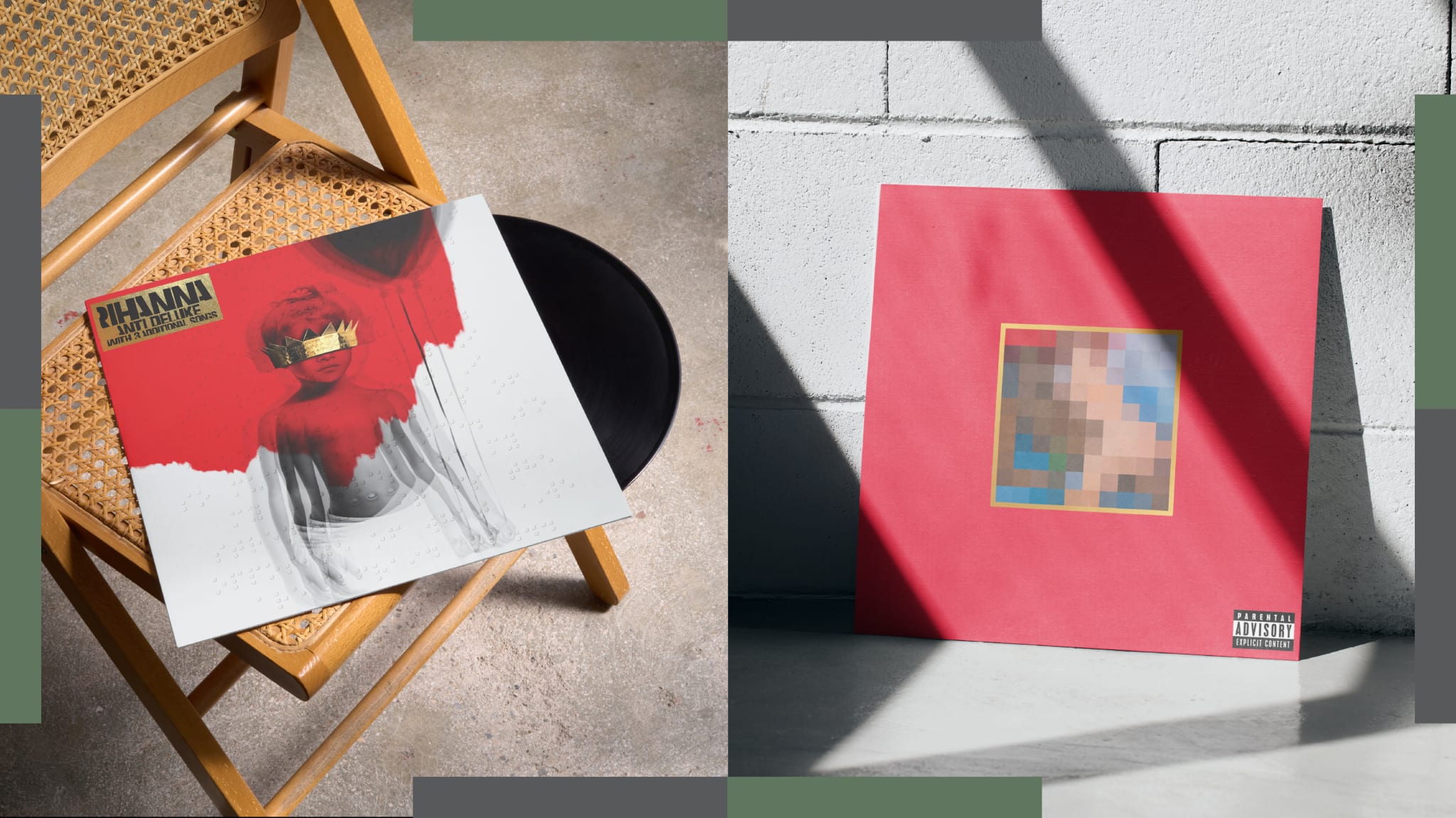
4.Rihanna, Anti (2016)
Label: Westbury Road/Roc Nation
Who needs R9 when you have Anti?
Up until her eighth studio album, the Bajan R&B-pop powerhouse had been unstoppable, delivering back-to-back eras that matched her ever-changing hairstyles—evolving from a good girl to a ‘bad gal’ while racking up hit after hit. By the time Anti arrived, Rihanna had little left to prove and everything to express.
She made her stance clear on the skittering, SZA-penned “Consideration,” signaling the emotional range she would explore. She surrendered to desire on the island-infused “Work.” On the edgy “Desperado,” she questions whether a stormy relationship is worth the struggle. And with Mustard-produced “Needed Me,” she delivered an iconic kiss-off, illustrating her natural command.
Despite six Grammy nominations, Anti won no awards, which may explain why Rihanna isn’t rushing to release another full-length album. Even so, it marked her first step in a bold, undaunted direction, showcasing an artist unafraid to redefine herself. —Jaelani Turner-Williams
3.Jay-Z, The Blueprint (2001)
Label: Roc-A-Fella/Def Jam
Released on 9/11, Hov’s fifth proper solo album is a historic feat of cohesion, craft, and persona
Depending on the track, HOV could make a stabbing charge look like Nelson Mandela martyrdom (“The Ruler’s Back”) or a rebel theme song a journey through a hustler’s soul (“Renegade”). Here, he distills ghetto and celebrity ecosystems into tightly wound couplets that were as detailed as they were meticulously rhymed.
And then the hooks were simultaneously fun and symbolic enough to be eternal. And Just Blaze and Kanye West simply made the hardest beats you’d ever heard in your life. And Jay connected it all with the best kind of self-mythology; real stakes with the winking wit to conjure a hero’s defiance: “Mr. District Attorney, I don’t know if they told you/I’m on TV every day—where the fuck could I go to?”
Playing “U Don’t Know” in Madison Square Garden is as singularly American as a triple cheeseburger and an extra large Coke. Like Avatar Aang, 2001 Hov had mastered all of the elements; he could make a rhyme burn and a hook soar. A song cry. Literally speaking, a blueprint is supposed to be a set of schematics that make a construction systematically replicable. With its blend of the best rapping and the best choruses and the best beats and the best story arc, this set of building plans is one only Hov could execute. —Peter A. Berry
2.50 Cent, Get Rich or Die Tryin’ (2003)
Label: Interscope/Shady/Aftermath/G-Unit
This asshole, this incredible writer of songs with a God-given gift for melody, can’t open his mouth without pissing off another powerful person. He named himself after a stickup kid, so why wouldn’t he make a whole song calling out individual rappers and robbing them?
He’s from Queens, so why not air all the Supreme Team’s dirty laundry on a song that names names and will eventually get him shot nine times? 50 Cent survives the shooting and, more miraculously, his career does too. His rise is worthy of Dumas, which he pulls off by simply upending the major label system, completely reimagining the facility of what a rap mixtape is, what it can be, and what it can do for your career along with two childhood friends, one of whom just happens to end up being the best punchline rapper of the aughts…and Tony Yayo.
But 50’s most subversive act is his debut album, a near perfect exercise in turning the rap LP into a workshopped, focus-grouped, four quadrant smash. The Southern-flavored anthem, the New York his-and-her-kicks R&B anthem, the street anthem, the club anthem—it all worked, by the sheer force of 50’s talent selling 12 million copies and convincing the rap industry that not everyone can produce a cut diamond effort like The Blueprint, so maybe better to throw a bunch of hits together. — Abe Beame
1.Kanye West, My Beautiful Dark Twisted Fantasy (2010)
Label: Roc-A-Fella/Def Jam
How ridiculous. The origin story of the greatest album of the last 25 years began with a Hennessy-fueled moment of fury at a B-list award show, and the backlash that followed. Yet greatness often emerges from adversity. After Ye infamously interrupted 19-year-old Taylor Swift’s Best Female Video acceptance speech at the 2009 VMAs, the rapper went into a self-imposed exile in—of all places—Oahu, Hawaii. What emerged was a perfect album.
And yes, My Beautiful Dark Twisted Fantasy is indeed perfect—an album so rich with texture, packed with ambition, and obsessively detailed that every string selection, drum pattern, keyboard note, synth line, and verse feels meticulously labored over. It’s the album you get when you have $3 million from Def Jam to burn—and the foresight and pull to bring together the younger figures who inspire you (Kid Cudi, Big Sean), the contemporaries who push you (Pusha T, Rick Ross), and the OGs who helped build you (Q-Tip, RZA) in one room. It's a collection of rap talent so great you could have taken a “great day in Oahu” picture.
From there, Ye and co. built a maximalist masterpiece: a modern-day album that used ’90s boom-bap as its foundation, layering all the lessons Kanye had learned over the years: the chip-on-the-shoulder energy of The College Dropout, the cinematic textures of Late Registration, the anthem-making of Graduation, and the intensity of 808s & Heartbreak.
The flourishes get more audacious as the album progresses: the choir and strings on “Dark Fantasy,” the extended outro on “Power,” the monumental horns on “All of the Lights,” that fucking electric guitar solo on “Devil in a New Dress,” back-to-back posse cuts where he lets the rookies—Nicki Minaj and Cyhi the Prynce, respectively—take the spotlight.
There is some irony in this being the best album of the century. In many ways, it signals the last capital-A rap album. Some artists have tried: good kid, m.A.A.d city had a similar singular focus but lacked spectacle; Drake’s Take Care shared a sense of flourish but not the same tightness; Dr. Dre’s Compton had the resources but not the songs. These were mostly outlier attempts. As the decade progressed, albums became more indebted to the freewheeling mixtapes of the 2000s—looser, more like collections of experiments than cohesive visions. Even Kanye himself embraced this shift. After creating a blockbuster, he went smaller and more abstract with Yeezus, then entered full-on obsessive mad-science mode on The Life of Pablo. And he less said about post-2016 Kanye, the better.
But My Beautiful Dark Twisted Fantasy stands as the ultimate Ye album: the artist of the century at the peak of his power. Kanye would later describe it as an apology of sorts for all the VMAs bullshit, but it really feels more like a defiant “how dare you.” —Dimas Sanfiorenzo