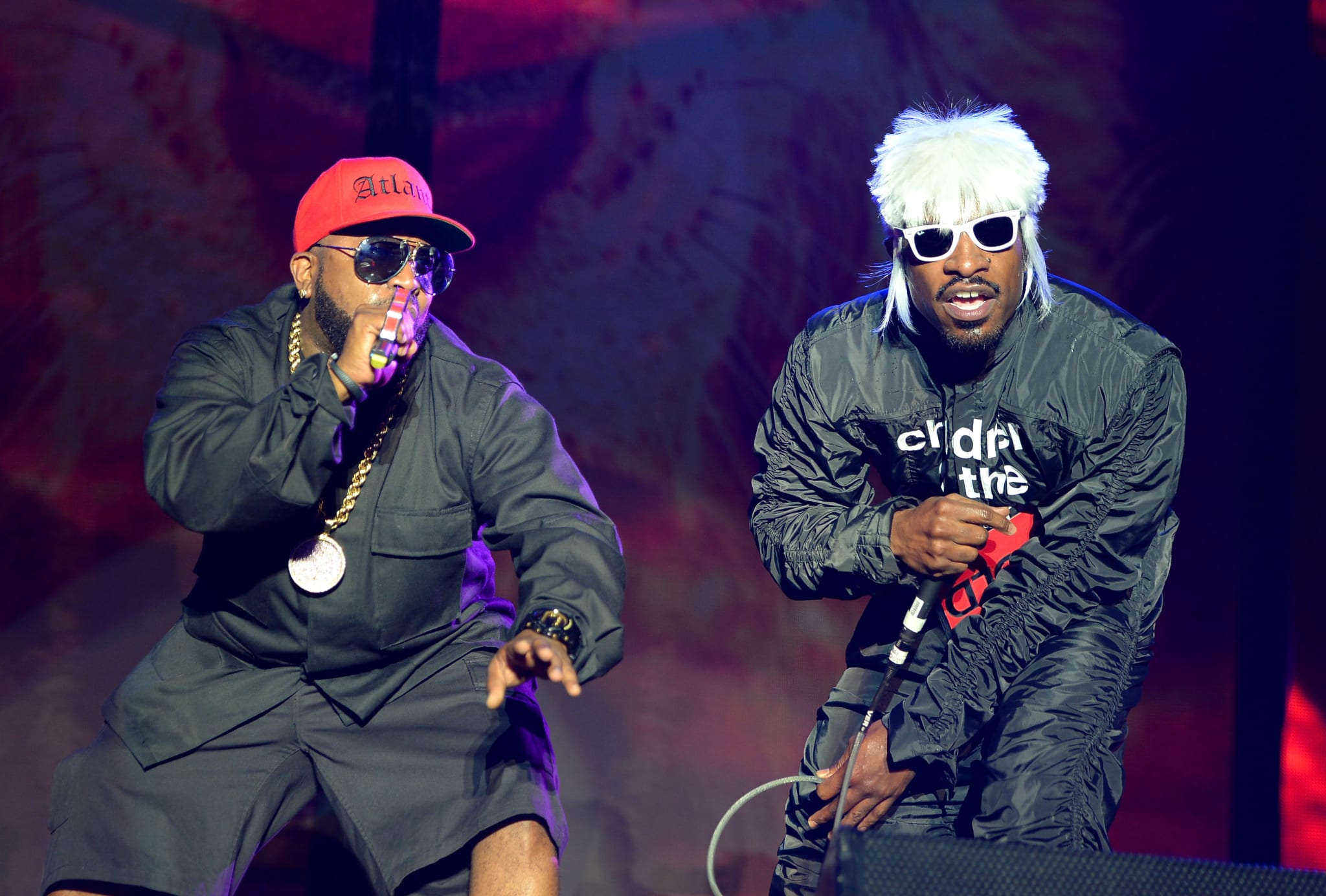
If OutKast’s catalog were a meme, it would be: “Never let them know your next move.” André 3000 and Big Boi built their legend on keeping listeners guessing—even poking fun at their constant reinvention on their third album, Aquemini.
“First they was some pimps, man,” a fictional record store customer gripes on an interlude, alluding to the Atlanta duo’s debut. “Then they was some aliens, or some genies, or some shit. Then they be talkin’ about that Black righteous space. Man, whatever.”
You couldn’t put OutKast in a box if they were a fresh pair of gators.
That’s the beauty of running back their discography: Every album sounds like a new world, fueled by the push-and-pull between Big Boi and Dré. It’s bittersweet to know creative distance eventually stalled their output, but that same contrast gave the music its edge. It’s a big reason ’Kast remains one of the most progressive and influential groups hip-hop has ever seen.
Big Boi was the anchor: a slick, streetwise storyteller with a knack for turning A-Town plight into poetry you can see. André was the dreamer, reaching beyond rap to chase the freedom of guitar heroes like Hendrix and innovators like Prince. Together, they created a daring catalog that can stack up against the all-time greats.
It all started at Tri-Cities High School in East Point, where Antwan Patton and André Benjamin linked up as students. But the real musical education came in the cramped basement recording studio of Organized Noize producer Rico Wade, affectionately known as the Dungeon. That’s where these two dope boyz from the A crafted their 1994 maiden album, Southernplayalisticadillacmuzik, proving there were rich, distinctly Southern stories worth telling beyond the era’s East-West hip-hop binary.
No one could’ve predicted what came next: harmonica hoedowns (“Rosa Parks”), hyperspeed rule-breakers (“B.O.B. (Bombs Over Baghdad)”), sung serenades (“Prototype”). But that’s kind of the point.
You wish Three Stacks and Sir Luscious Left Foot kept tugging at the limits of what hip-hop could look, feel, and sound like. But OutKast’s influence continued long after their final album, 2006’s Idlewild. They passed their DNA to generations of artists from Atlanta (T.I., Future, J.I.D.) and beyond (Ye, Kendrick Lamar, Tierra Whack). The self-proclaimed coolest motherfunkers on the planet gave hip-hop permission to be weird, to explore new sounds and styles, to keep listeners guessing.
With Big Boi and André 3000’s recent induction into the Rock and Roll Hall of Fame, there’s no better time to take a funky ride through the OutKast canon. Here’s a look back at their studio albums, ranked from worst to best.
6.Idlewild (2006)
Label: LaFace
Producers: Organized Noize, Big Boi, Johnny Vulture (André 3000), Mr. DJ, Whild Peach, Nate “Rocket” Wonder, Jeminesse Smith, Kevin Kendricks
Features: Lil Wayne, Snoop Dogg Sleepy Brown, Khujo, Scar, Janelle Monáe, Killer Mike, Whild Peach, Macy Gray
Speakerboxxx/The Love Below was Outkast’s most ambitious undertaking. When it turned out to be the pinnacle of their success, they decided to play with house money.
Big Boi and André dove deep into the multi-layered Idlewild, a film and then a film soundtrack. The movie starred both MCs in a star-studded period piece musical set during the Prohibition era. While the film soundtrack sounded like the big band jazz and ragtime of that time period, their album, Idlewild, was a collection of new material unrelated to the film, but borrowing from its aesthetic and spirit. Tracks like “Morris Brown,” “Mighty O,” “Call the Law,” and "Idlewild Blue (Don'tchu Worry 'Bout Me)" saw the MCs playing with Delta Blues, HBCU marching bands, and electrofunk.
However, at this point, the chemistry between the two had changed. Their different tastes no longer complemented each other the same way they had before, which makes the fact that this turned out to be their final album to date a shame. Idlewild reminds me of The Beatles’ Let It Be or A Tribe Called Quest’s The Love Movement; a competent album with a handful of great tracks that ultimately made for an anticlimactic swan song. —Matthew Allen
5.Speakerboxxx/The Love Below (2003)
Label: Arista
Producers: Big Boi, André 3000, Mr. DJ, Carl Mo, Dojo5
Features: Sleepy Brown, Jazze Pha, Killer Mike, Bamboo, Konkrete, Big Gipp, Ludacris, E-Mac, Jay-Z, Khujo, Cee-Lo, Henry Welch, Slimm Calhoun, Lil Jon & The East Side Boyz, Mello, Toni Hunter, Rosario Dawson, Fonzworth Bentley, Kelis, Norah Jones, Qasha Aman
After the commercial success of Stankonia, Outkast was on the brink of splitting up.
Big Boi was on the verge of doing his first solo album, while André had committed to stretching out as an actor. But weeks before Big Boi was due to release his solo debut, André submitted an album's worth of songs of his own to be included as a companion. The result was Speakerboxxx/The Love Below. Fans noticed the gap between the contrasting MC styles of the two rappers steadily increased with each album. So, Speakerboxxx/The Love Below was the logical presentation—two solo albums as one project, although they each made contributions to the other.
Big Boi’s Speakerboxxx disc was a tight exercise of fusing hip-hop and funk with danceable tracks like “The Way You Move,” “Bowtie,” and “GhettoMusick.” Andre’s Love Below disc was an eclectic experimentation. Songs like “Hey Ya!,” “Prototype,” and “She Lives in My Lap” had influences of soul, drum-n-bass, electronica, pop, and Minneapolis musings, while André chose to sing on all but two tracks.
The gamble paid off commercially, selling over 10 million copies and becoming only the second hip-hop project to win a Grammy for Album of the Year. However, in the context of their catalogue, Speakerboxxx/The Love Below is something of a disappointment, never reaching the creative highs of their earlier work. —Matthew Allen
4.Southernplayalisticadillacmuzik (1994)
Label: Arista/LaFace
Producers: Organized Noize
Features: Goodie Mob
Back when New York City and Los Angeles were deadlocked in a hip-hop tug-of-war—a time when calling someone “country” was considered shade—André 3000 and Big Boi firmly planted their flag in Atlanta’s red clay terrain. Distinct from the Afrocentrism of Arrested Development and Kilo Ali’s ass-shaking bass music, OutKast’s debut was the potion that gave their city motion (and an identity): Southern-fried stories about gangstas, pimps, and hustlers, narrated by two teen prodigies still finding their way.
Even in their earliest verses, you can hear the spark of what made OutKast legendary. The title track and “Ain’t No Thang” serve up irresistible hooks and twang. “D.E.E.P.” finds Big Boi kicking street wisdom and his signature one-liners (“I’m gettin’ deeper than that prostitute's vagina”). “Crumblin’ Erb” is smoother than suede Caddy seats, a smoke-filled meditation from a young duo already thinking beyond MARTA limits. And the album’s breakout single, “Player’s Ball,” gave Christmas a new kind of jingle. Backed by Organized Noize’s original instrumentation, these songs feel alive, swelling and pulsing with soul and flavor. OutKast went on to reach greater musical peaks, but Big and Dré’s rookie album is a landmark that lit the way for a generation of spitters who’d never been prouder to call ATL—or anywhere in the South—home. —John Kennedy
3.Stankonia (2000)
Label: Arista/LaFace
Producers: Earthtone III (Outkast and Mr. DJ), Organized Noize, Carl Mo
Features: Khujo, Killer Mike, J-Sweet, Gangsta Boo, Eco, B-Real, Backbone and Big Gipp, Erykah Badu, Slimm Calhoun, C-Bone and T-Mo, Cee-Lo, Sleepy Brown, Big Rube
The story of Stankonia began far away from the A, when André 3000’s ears perked to the sound of drum and bass while OutKast toured London in 1999. Hip-hop hadn’t been moving him. That rapid percussion did. From that seed sprouted “B.O.B. (Bombs Over Baghdad),” a 155-BPM explosion that fused high-octane rhymes, electric guitar licks, and a down-home gospel choir into something gloriously alien. At a time when mainstream rap leaned sleek and glitzy, OutKast let its freak flag fly and reimagined what the genre could sound like. Again.
That experimental urge courses through OutKast’s superstar-making fourth album, the moment when Big Boi and Dré went from Atlanta advocates to cartographers of hip-hop’s future. Stankonia gave era-defining hits (“Ms. Jackson,” “So Fresh, So Clean”), a fiery Killer Mike introduction (“Snappin’ & Trappin’”), and the genesis of André singing his heart out.
Alongside producer Mr. DJ, OutKast pushed musical boundaries by blending funk, psychedelia, rock, and soul into a sound that still feels radical, all while getting real about everything from hip-hop materialism to teenage pregnancy (“Toilet Tisha”). You don’t get Kendrick Lamar’s To Pimp a Butterfly, Janelle Monáe’s The Arch-Android, or Childish Gambino’s Awaken, My Love! without Stankonia blazing the trail. —John Kennedy
2.ATLiens (1996)
Label: Arista/LaFace
Producers: Organized Noize, Outkast
Features: T-Mo, Khujo, Big Gipp, Cool Breeze, Witchdoctor,
After earning their stripes with their debut album, what did OutKast do for an encore? They went left, and they went dark.
ATLiens leaned into the harsh realities that rap notoriety still hadn’t equated to becoming rich beyond their wildest dreams, exemplified beautifully in the album’s two most iconic tracks, “Elevators (Me & You) and the title track. However, songs like “Two Dope Boyz (In a Cadillac), and “Decatur Psalm” found André and Big Boi doubling down on their devotion to their hometown.
While Organized Noize returned as the primary production team, Outkast also began producing some tracks themselves, without sacrificing any sonic cohesion. “Wheelz of Steel” and “Elevators” previewed the duo’s growing production acumen and their signature fusion of brooding live instrumentation with the guttural drum programming characteristic of The Dungeon. ATLiens also highlighted Outkast’s unique brand of Afrofuturism—from the album’s comic book styled artwork to the otherworldly, drumless textures of “ET”—a sound they would continue to refine on subsequent releases. —Matthew Allen
1.Aquemini (1998)
Label: Arista/LaFace
Producers: Outkast, Organized Noize, Mr. DJ, Donny Mathis
Features: Raekwon, George Clinton, T-Mo, Big Gipp, Khujo, Cee-Lo, Erykah Badu
Fans were not deterred from Outkast following ATLiens’ darker sonic descent from Southernplayalisticadillacmuzik.
In fact, they became even more invested in the duo, now that Outkast had proven there was more to them as MCs and producers. Their third album, Aquemini, saw the pair taking greater control of their musical vision. They went from producing five of ATLiens’ fifteen tracks to nearly half of Aquemini, with Organized Noize still a major presence and newcomer Mr. DJ joining the fold.
The album title was a combination of Big Boi’s and Andre’s astrological signs, illustrating how the contrasting flows, personalities, and points of view of each MC complemented each other instead of clashing. Songs like “Rosa Parks,” “Liberation,” “The Art of Storytelling,” and the title track found the duo reaching a new gear that no one could predict. Their rhymes were crisp, confident, esoteric, and poignant, while the music was more vast, adventurous, and risky. What other rap group could make a harmonica solo on a song bridge (“Rosa Parks”) and do a seven-minute spoken word track led by bombastic brass (“SpottieOttieDopaliscious”) and make it work? —Matthew Allen