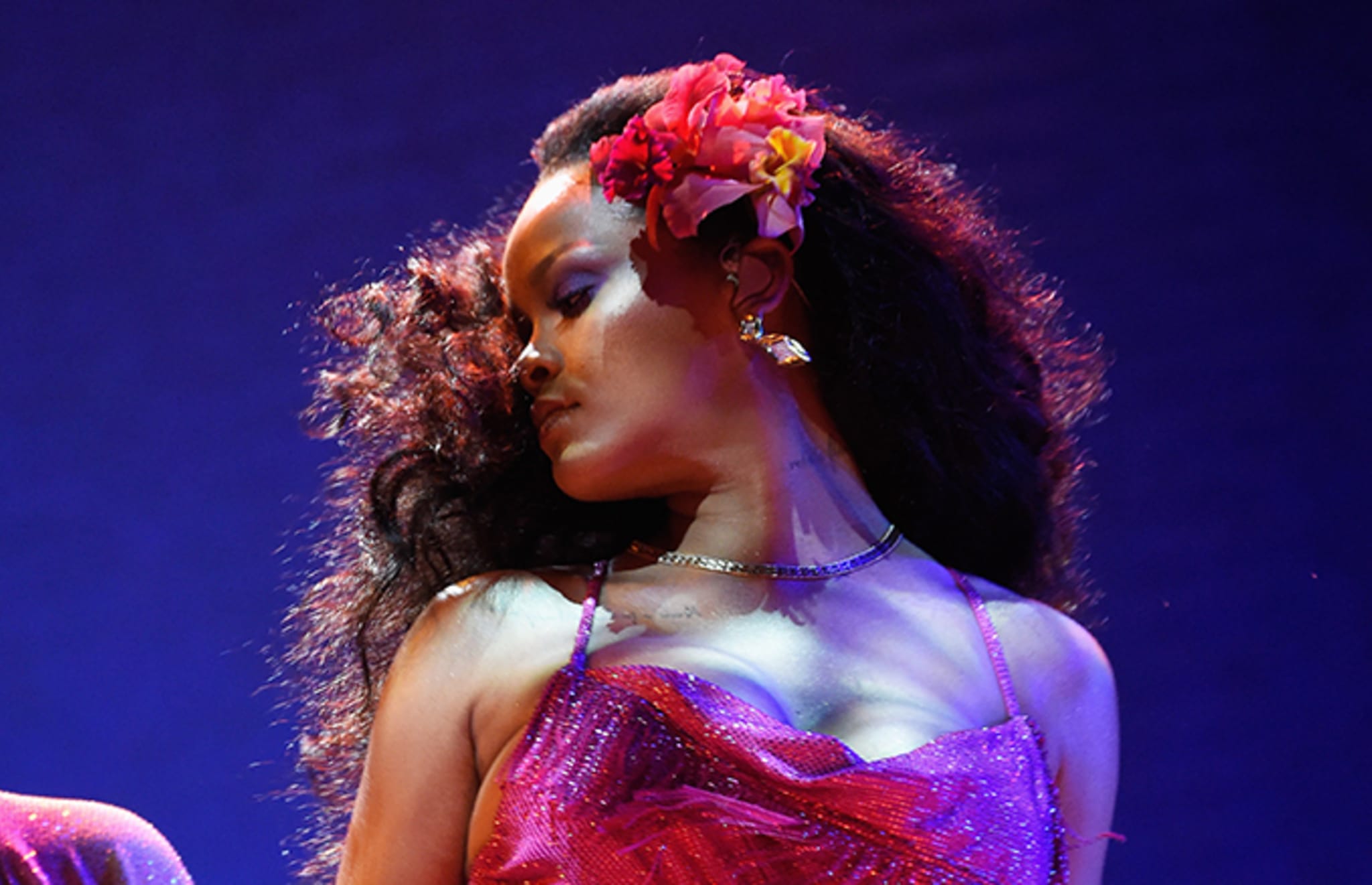
Image via Getty/Kevin Mazur
Rihanna is now a household name, but it’s been a journey to get here. She began her foray into the music biz at just 15-years-old, when she formed a girl group with two of her friends in her native Barbados and was soon discovered by producer extraordinaire Evan Rogers. He saw the potential in Ri, and opted to leave her bandmates behind. She eventually made her way stateside, recorded “Pon de Replay,” and grabbed the attention of one Jay-Z. The rest is history.
Now, Rihanna has eight studio albums to her name, spanning all kinds of genres and feelings and texturesFrom her sweet, youthful Caribbean sounds to the sultry explicitness of her later work, Rihanna is fearless in broadening her horizons. There's a lot of ground to cover. Rihanna is often painted as a singles artist, but there are many album cuts that warrant your time, too. We've dug through the best of the best. These are the 30 best Rihanna songs.
“Break It Off” f/ Sean Paul (2006)
Album: A Girl Like Me
Long before Rihanna was breaking records and dominating the Billboard Hot 100, she was a teenager from Barbados looking to break into the U.S. mainstream market while remaining true to herself and her Caribbean roots. The best (and unfortunately, oft-forgotten) example of this is “Break It Off” from her second record, A Girl Like Me, featuring Jamaican rapper Sean Paul. In the mid-aughts, Paul was at the top of his game, and Ri was a relatively unknown up-and-comer. Their collaboration stands the test of time—it’s the best of both words, hinting at Rihanna’s future penchant for genre experimentation and hybridity. —Maria Sherman
“Cold Case Love” (2009)
Album: Rated R
Somewhere between a ballad and a banger, "Cold Case Love" very much feels like discarded material from its co-writer Justin Timberlake's FutureSex/LoveSounds sessions, down to its all-too-literal lyrics. The instrumentation builds on itself, much like JT's "Losing My Way," the opening church organ joined by woodblock, then string instruments and real piano, creating a cushion for the heartache in Rihanna's voice. After the very public and devastating end to her relationship with Chris Brown, the song becomes a diary entry. But when its sparse opening becomes a full orchestral cloud, it transforms from a song about defeat to a song about triumph—the very thing Rated R, as an album, set out to do.—Claire Lobenfeld
“Needed Me” (2016)
Album: ANTI
If Rihanna’s “Cockiness” were Michael Jackson, her “Needed Me” would be Janet, or at the very least, Jermaine when he had a few hits in the 1980s. It’s slower in its tempo but no less poignant in its delivery. Here, Rihanna, over a different than business-as-usual DJ Mustard production, talks her shit as only she can. Very few people can dismember a person and put his ego on blast better than Rihanna. Savage indeed. All hail. —Michael Arceneaux
“Jump” (2012)
Album: Unapologetic
Sure, the EDM guy is all about the dubstep track from Rihanna's Unapologetic. Typical, right? Think about how many EDM acts Rihanna's worked with, though: She's done tracks with David Guetta, members of Knife Party, and numerous tracks with Chase & Status, who worked with StarGate on this very tune. Yes, this can get kind of "wubby," but Rihanna has the flair to knock this one out of the park without flexing too crazy. Many people were drawn immediately to the use of Ginuwine's "Pony," but you can't sleep on the hefty dubstep drop that immediately follows. It's one of the true gems off of Unapologetic, and it not only highlights how diverse Rihanna can be sonically, but showcases how easily dubstep can be thrown into modern pop and R&B without sounding cheesy. —khal
“Hard” f/ Jeezy (2009)
Album: Rated R
The best part about "Hard" is that when she sings about being it, she doesn't even have to emphasize it. She mush-mouths and sweetens the chorus and slurs most of the verses, letting Young Jeezy's brick-heavy delivery act as her snarling, punch-lined proxy. Co-written by some of her greatest collaborators, Tricky Stewart and The-Dream, it's not a lot in the way of melody—it's more about those two asserting her supremacy for her, while all she's got to do is show up and stay within the range of a talky couple notes.
“Cockiness (Love It)” (2011)
Album: Talk That Talk
Rihanna was definitely talking that talk: On a humpy bass line that meant business, the concept of "cockiness" wasn't even a metaphor, but a conceptual portmanteau of her spiritual cojones and her actual clit. Say what you want about other people writing this song—Bangladesh on the beat (built off a freaking Greg Kinnear sample), Candice Pillay on lyrics—it takes an unflappable strength and confidence to turn the powerfully direct chorus "I love it when you eat it" into a pop mantra. It's a glimpse into the 50-foot Rihanna that would give us "Pour It Up" a year later.
A good part of it was her patois rap bridge, which delved into dancehall territory and invoked Shabba ("Hold me tight, mister lover"), but underscored that this love is purely procedural: You don't address a dude as "homie" unless you're tryna keep it caj'. But the song's sexuality lies mostly in its pure minimalism, Rihanna nimbly weaving through the beat thump, doubling down on the hard consonants, especially those in the word "dominatrix."
Live, she accompanied this song with one of maybe four dance moves in her repertoire. Just her staple butterfly wine with a little chop-chop motion on her crotch, the CEO of her own rampin shop. —Julianne Escobedo Shepherd
“Diamonds” (2012)
Album: Unapologetic
It's not surprising that a slow-paced power ballad helped Rihanna get her first No. 1 album when you consider her vocal performance and emotional connection in this song. The lyric "I chose to be happy" sounds practical and sweet alone, but sounds so tragic in a minor key.
What's special about this song is that it's one of Rihanna's personal favorites. You can see how her face changes when she talks about this one, dedicated to her late grandmother and other loves of her life. People who criticize Rihanna for being a detached performer have never seen her sing "Diamonds." —Soo-Young Kim
“Watch n’ Learn” (2011)
Album: Talk That Talk
Rihanna will always be an island girl. She's included dancehall tracks on all her albums since her debut, Music of the Sun, which even boasted a cover of Dawn Penn's iconic "No No No (You Don't Love Me)" with an assist from Vybz Kartel. Her sixth release, Talk That Talk, blessed with the reggae-tinged stunner "Watch 'N Learn." Rihanna co-wrote the track with Priscilla Renea, Alja Jackson, and Hit-Boy, who doubled as producer, helping her to capture the playful vibe that makes her sex appeal so much fun. True to dancehall form, it's about getting physical. But here, Rih leaves her whips and chains at home in favor of a little teasing and taunting: Anyone trying to give it to her the right way might need a little guidance. But hey, the prospect of loving Rihanna is a daunting one—and instructive demonstrations are the best way to learn. —Dana Droppo
“FourFiveSeconds” f/ Kanye West & Paul McCartney (2015)
Album: N/A, Single
Of all the pop music juggernauts that dominate cultural conversation, Rihanna is continuously one of the most challenging heroines to describe—her performances differ and in their plasticity, possess an ineffable quality: not unlike the practices of fellow collaborators Kanye West and Beatles bassist Paul McCartney, she can make her idiosyncratic voice work for any kind of music. In “FourFiveSeconds,” she adopts almost a breathy-Janis Joplin tone. Rihanna’s rasp is one of her most underutilized talents, and here, it’s at the forefront. —Maria Sherman
“Wild Thoughts” DJ Khaled f/ Rihanna & Bryson Tiller (2017)
Album: Grateful
In the spring and summer of 2017, two songs dominated the radio waves and our collective eardrums: a Justin Bieber remix of “Despacito,” by Puerto Rican musicians Luis Fonsi and Daddy Yankee (a small victory for Spanish-language music) and DJ Khaled featuring Rihanna and Bryson Tiller’s “Wild Thoughts.” The latter song is a true epic—only Rihanna can make crooning and mumbling about getting naked on top of a sample of Santana’s “Maria” sound dope as hell. It’s true: when Rihanna hops on a song, she’s almost always the first and last voice you hear on record—she’s no side note, she’s the main attraction. At this point in time, it’s no understatement to say that her hooks make things go gold, platinum and beyond. It’s early yet, but the resonance of “Wild Thoughts” already feels massive. —Maria Sherman
“Pon de Replay” (2005)
Album: Music of the Sun
When “Pon de Replay” by a then-unknown singer from Barbados hit the airwaves in summer 2005, it was a welcome presence but not exactly a standout; Jamaica’s pop chart breakthrough had begun a few years earlier and had started to wane. The Diwali rhythm (think Sean Paul’s “Get Busy” and Wayne Wonder’s “No Letting Go”), “Pon de Replay”’s obvious precursor, had washed through the American conscience, as had numerous American-made knock-offs (Timbaland is a god, but “Pass That Dutch”’s handclap mania felt clumsy in comparison to its inspiration). It was the summer of Mariah’s radio-dominating slow jam “We Belong Together.” I first heard the song in my mom’s ’91 Volvo, blasting out of a radio with a broken volume button, where my only option was, literally, to turn up.
Looking back, “Pon de Replay” feels more of a spiritual piece with Rihanna’s later, “Rude Boy”-era material than it would mid-period Rihanna singles like “Umbrella.” “Pon de Replay” had a strangely appropriate vibe for a career that embraced an internationally-facing audience. She is a product of a world drawn closer together by the massive industries of popular music and the democratizing effects that four-on-the-floor groove. Especially once house finally broke through into America, making it a truly international template for dance. —David Drake
“Don’t Stop the Music” (2007)
Album: Good Girl Gone Bad It’s tough to remember, but when this song first broke, it was one of the earliest shots fired in the mainstreaming of dance music. At the time, it felt like a refreshing rarity, one of a handful of tracks in ’07 (think: Jay Z’s “Ignorant Shit,” Timbaland’s “The Way I Are”) that suggested a four-on-the-floor house beat was a way “out” of R&B’s seeming stasis.
Of course, Rihanna—as well as pop music more broadly—would go on to embrace the house groove (soon to be rechristened EDM) and blanket the airwaves with it. “Don’t Stop the Music,” heard now in the Zedd “Clarity” era, feels positively conservative, stripped down, and minimal: a throwback Michael Jackson sample suggests the setting. There are two clubs: the one inside the world of the song, where Rihanna calls to the DJ spinning MJ, and reality, where we share Rihanna’s internal monologue as if it were our own. An exuberant celebration of the club as a space of liberation and escape, “Don’t Stop the Music” was a sign that Rihanna was about to be the vanguard of a new pop order. —David Drake
“Disturbia” (2007)
Album: Good Girl Gone Bad
"Don't Stop the Music" was Rihanna putting one toe into the EDM pool, but "Disturbia" was her diving into it head first and getting a No. 1 single out of it. No wonder Rihanna and her team love to experiment with new sounds—it's always a risk that pays off. Her singing style works really well with this type of pop, and the catchy "dum-dum-di-dum" chorus makes it impossible to get out of your head.—Soo-Young Kim
“Man Down” (2010)
Album: Loud
"Man Down" is Rihanna's most cinematic, from the 22 she calls Peggy Sue that fits right into her shoe to the hook's wispy falsetto. But it got a second life in 2012 when Australian radio jocks Hamish & Andy tongue-in-cheekily accused her of stealing the "rum-pa-pa-pum" from a previous interview with them and "'The Little Drummer Boy' from biblical times." It transforms a song about accidental manslaughter from downtrodden to adorable, one devilish grin at a time. Bonus points for a flood of her accent.—Claire Lobenfeld
“Pour It Up” (2012)
Album: Unapologetic
Although not Rihanna’s biggest single in the pop sphere, her flip of the Mike Will “Bandz a Make Her Dance” formula dominated R&B radio for months. A celebration of the insulation only money can provide, the song has a simmering control, her melodies less interesting for the emotions they convey than for the ones that they don’t: She is withholding herself from her subject, drawing attention to the emotionlessness of the exchange. It’s the eroticism of control and power, the kind provided only by the money on her mind. The contrast is made even more stark by her one emotive cry—a mournful lament, or is it merely a display of strength?—before describing the field of dollar signs she sees in front of her stretching into infinity. —David Drake
“Loveeeeeee Song” f/ Future (2012)
Album: Unapologetic
When you write for Rihanna, you have to hit the exact mark she wants, or else it's curtains (see: "We Can't Stop"). Not only did she want Future's rich-in-emotion, sensory style for her seventh LP, she wanted to sound exactly like him. She followed his "Loveeeeeee Song" demo to a tee, employing his syrupy flow. And when you combine the two singing together, you get one of the sincerest songs about emotional desire this side of Frank Ocean. Relationships have been founded on it. Relationships have dissolved because of it. Relationships will be dreamed of while this song plays in the background.—Claire Lobenfeld
“Take Care” Drake f/ Rihanna (2011)
Album: Drake, Take Care
Rihanna was early to the pop obsession with house music. By the time "Take Care" dropped in late 2011, she'd already scored No. 1 hits with the bleating bangers "(Only Girl) in the World" and "S&M." But this, a collaboration with Drake based on a beat by Jamie xx, was something totally different: soothing and sensual, tender at a time when she was so happy to be in everybody's face. Even without that context, this is easily one of Rihanna's most stunning vocal performances. You can hear the pain in her voice when she sings, "I've loved and I've lost," but she's also the track's center of gravity, providing the strength Drake doesn't have. —Jordan Sargent
“Love the Way You Lie” Eminem f/ Rihanna (2010)
Album: Recovery
There was a period at the beginning of this decade where no one could light a candle to Rihanna’s balladry—not necessary in her heartbreaking prowess, though 2012’s “Stay” is an undeniable classic—but in her ability to deliver a mournful tone with such an incredible ease. There’s a rawness, an authenticity to everything Ri does, but when it comes to feeling broken of loosing love, she manages to find empathy in her past and present selves, resulting in timeless sounds music. Now if only we could say the same for Eminem! Kidding…or are we? —Maria Sherman
“You Da One” (2011)
Album: Talk That Talk
It's the island attitude Rihanna throws into her voice that makes "You da One" a perfect pop song. The lyrics would be middle school notebook decoration if it weren't for that tweak of "the" to "da." Makes a world of difference, really. The little dubstep breakdown portion marks the song as firmly 2010s, but it'll still age well because the break is anchored by all that goddamn personality in the way she sings the word "one." You can hear how she practically bites down and pulls up on the syllable, pulling the ne away from the vowel like a single bright stream of taffy extending from the candied o to her lips. You can picture it, too. This is the one. —Ross Scarano
“Stay” f/ Mikky Ekko (2012)
Album: Unapologetic
Rihanna is championed for many things, but sheer vocal performance isn't necessarily the talent her name is built on. "Stay," her duet with Mikky Ekko from 2012's Unapologetic, is the song that transformed Rihanna from a star into an artist. The song and video alike are simple, stripped down, and raw with emotion. The power of her vocal performance in "Stay" is enough to silence Rihanna's greatest critics—she delivers tender, believable vocals carrying the weight of truly wanting someone. It's as though Rihanna's voice was just waiting for a songwriter as talented and open as Ekko to tease this out of her. —Dana Droppo
“Same Ol’ Mistakes” (2016)
Album: ANTI
Very few people could have predicted that Rihanna would have opted to cover Australian psych-rock band Tame Impala's “New Person, Same Old Mistakes,” but it’s not surprising to see how beautiful her interpretation proved itself to be. The only other song I can think of in which Rihanna sounds this ethereal is the grossly underappreciated “Get It Over With,” and both prove that Rihanna’s voice can be moving. I could hear this song for the rest of my life—ideally at last call at a bar in which I can’t help but sing my heart out. —Michael Arceneaux
“What’s My Name?” f/ Drake (2010)
Album: Loud
One of the most fun things about "What's My Name?" is thinking about how happy Drake must've been to be making a song with Rihanna. This is reaching, probably, but doesn't Drake just seem like one of those hopeful guys who gets gassed just being around his crush? Like, he's sad a lot but then maybe he goes back and looks over some old texts from her and digs into that really bittersweet feeling the messages from nicer times conjure. And then, oh shit, he's at the bodega, and there she is, the beloved. Rihanna's got Drake so open, he's trying to do math. (For more on the connection between arousal and arithmetic see Waits, "Pasties and a G-string.")
Meanwhile Rihanna sings with easy confidence about needing a boy to go down on her. This guy could do in a pinch, she thinks, idling by the beverages cooling behind glass. —Ross Scarano
“Where Have You Been” (2011)
Album: Talk That Talk
Dance music is known historically for the anonymity of its auteurs. It’s why dudes dress up in mouse ears like Deadmau5 or robot costumes like Daft Punk; they’re more logos than men. Their art comes through not the theatrics of pop but in its functionality: how it makes you move on the dance floor, or on muddy festival grass, or on drugs.
Dance music’s move into the popular realm only magnified pop music’s power. And no better example exists of this than the undulating magnificence of “Where Have You Been.” The song—produced by Dr. Luke, Calvin Harris, and Cirkut—packs a grab-bag of dance tricks but executes them with brutal economy. Jangling guitars to suggest her journey, trance patterns tapping out in the background, massive build-ups and dizzying breakdowns with synthesizers sawing through space. None of these were new tricks at the time, complain dance pedants, but none of them had ever been united in such a package, and for that, credit goes to Rihanna and “top line” vocal composer Ester Dean.
The introduction of a personality—for that is, again and again, something Rihanna provides in spades in her best material—has the effect of making dance music’s most immediate and powerful tools swoop in to support her. She’s no anonymous diva, the song’s push-and-pull coming directly from her dominant performance. The song has such a surfeit of complex, interwoven emotion, making the experience more human, more real: longing and confidence, certainty and confusion, a sense of time passing rapidly, but giving yourself up to the moment anyway. Where have you been? It doesn’t matter now. —David Drake
“Birthday Cake” (2011)
Album: Talk That Talk
Rihanna singing about sex? Good. Over a syncopated clap that inspires booty-popping? Great. With a pussy-patting dance that goes along with it? Even better. Sonically, you can tell the track is going to be naughty within its first few seconds, but as it's about to reach its apex, it fades out leaving you wanting so much more. —Soo-Young Kim
“We Found Love” f/ Calvin Harris (2011)
Album: Talk That Talk
For a song to reach critical mass like "We Found Love" did, it takes a certain combination of mastery, charisma, and perfect timing. The song gave us the perfect confluence of those elements. It's a club smash fueled by Calvin Harris' electro-pop expertise. It's got a repetitive hook that's immediately relatable, but it transforms to take on layers of meaning over the trajectory of the song. And it makes listeners feel like they're getting a taste of the deeply personal feelings of one of the most beloved pop stars on earth.
Rihanna may not have penned this song in her bedroom after her incredibly public relationship with Chris Brown, but it highlighted her vulnerability and humanity while she was facing blame and judgment. The song de-emphasized Rihanna's responsibility as a role and positioned her as a poster girl for the realities of youth.
Of course, Melina Matsoukas' iconic music video played a major role in that process. The combination of pills, cigarettes, butt-tattoos, arguments, dance scenes, and ribbon-vomit illustrate something essential about teenage love. Part of its lust requires giving in to every aspect of the relationship—even the things that can hurt you. "We Found Love" crystallizes that duality. As model Agyness Deyn so brilliantly narrates the opening monologue, "When it's over and it's gone you almost wish that you could have all that bad stuff back, so that you could have the good." —Dana Droppo
“Umbrella” (2007)
Album: Good Girl Gone Bad
Coming off her second album, Rihanna had four top 10 singles, including a No. 1 hit, but it was unclear if she'd ever really enter the pop pantheon. Her albums were promising but patchy and had yet to yield something undeniably timeless. That all changed the second the world heard "Umbrella"'s sweeping chorus, cemented by its iconic "ella-ella-ay-ay-ay" refrain. A ballad coated in chrome, "Umbrella" couldn't even be dented by a startling number of attempts at self-sabotage, including initial moves to give it to Britney Spears and Taio Cruz, producer Tricky Stewart ripping the drums wholesale from GarageBand, a totally needless remix with Chris Brown called "Cinderella," and Jay Z's entire verse.
All that assorted nonsense makes it even more amazing that "Umbrella" changed the course of music history. The-Dream immediately became the hottest songwriter in pop, and he would soon write some of Beyoncé's biggest hits and help launch Justin Bieber's career. It, and its subsequent album, Good Girl Gone Bad, was also when Rihanna started to become the edgy, individualistic and powerful pop star we now know her as. Rihanna will go down as an icon of our time. "Umbrella" is why. —Jordan Sargent
“Kiss It Better” (2006)
Album: ANTI
Another singer might’ve made this track sound cheesy as hell, but Rihanna has long proven she has a knack for making the seemingly banal a bigger moment than it may or may not have deserved. Rihanna made fans wait more than a year to hear this 1980s rock-leaning song in full. Now that we have, no wonder songwriter Glass John was so reportedly vexed at Travi$ Scott for allegedly delaying the release of “Kiss It Better.” It’s an obvious hit and had it been released as originally intended, we probably would’ve gotten ANTI far sooner. We will be hearing it forever and ever and ever. Rihanna’s that good. Fuck your pride indeed and fall into the magic here. —Michael Arceneaux
“Rude Boy” (2010)
Album: Rated R
Rihanna's Rated R was largely about post-heartbreak empowerment. She was throwing brawny barbs with haters-be-damned cuts like "Hard" and "Wait Your Turn." But then there was "Rude Boy," a bubblegum dancehall treat produced by StarGate. It may sound light and sweet, but Rih was ready to fully command her desires: "I like the way you touch me there/I like the way you pull my hair/Babe, if I don't feel it, I ain't fakin', no no." (Co-penned by one of pop music's nastiest songwriters, Ester Dean, natch.) There have been a number of transformative moments in Rihanna's career, but this song's salacious taunts were the first taste of the bedroom flexing she'd be unleashing on us throughout the rest of her catalog, to-date.—Claire Lobenfeld
“Bitch Better Have My Money” (2016)
Album: N/A, Single
At the risk of hyperbole: there are many gendered taboos that remain in mainstream culture, and Rihanna doesn’t give a single fuck about any of them. She quite literally murders a few in the epic “Bitch Better Have My Money” music video, which is cinematic in quality and deserved all the awards, but we digress. This single arrived right after the folksy “FourFiveSeconds” and before “Anti,” marking yet another step in RiRi’s unending evolution: she was experimenting with trap, and she was making it her own—while talking about getting her paper. In a world were inequalities of all kinds exist, especially for minority populations like women, people of color and especially women of color, “Bitch Better Have My Money” is not only catchy as fuck, it’s politically resounding. It’s a battle cry. This is Rihanna at her hardest because bitches get shit done. You better believe it. You better believe her. —Maria Sherman
“Only Girl (in the World)” (2010)
Album: Loud
No lie, Rihanna is important because of the way she demands. No song better explains this than "Only Girl (in the World)," the first single released from Loud. The song opens with what you could call girlishly sung "la la las." The beat is bright like video games and repetitive like something pre-programmed into a keyboard. So far, so fun, but nothing truly exemplary yet. And then Rihanna tucks her chin into her lower register and brings not just the song but the entire planet to a stop.
"Want you to make me feel like I'm the only girl in the world," she belts. The word is "want" as opposed to some kind of wartime ultimatum issued before the start of an air raid, but the feeling is that there is no other choice. Either Rihanna is made to feel like the only girl on the face of the earth, or she walks away from this dinky rock without letting it start turning again. She's brought the world's rotation to a halt, and the only real option is to meet her demands. At the end of the day, we all have to please Rihanna. It's a tall order, but there can be no other way. And so we submit. It's most fun that way. —Ross Scarano