Image via MGM
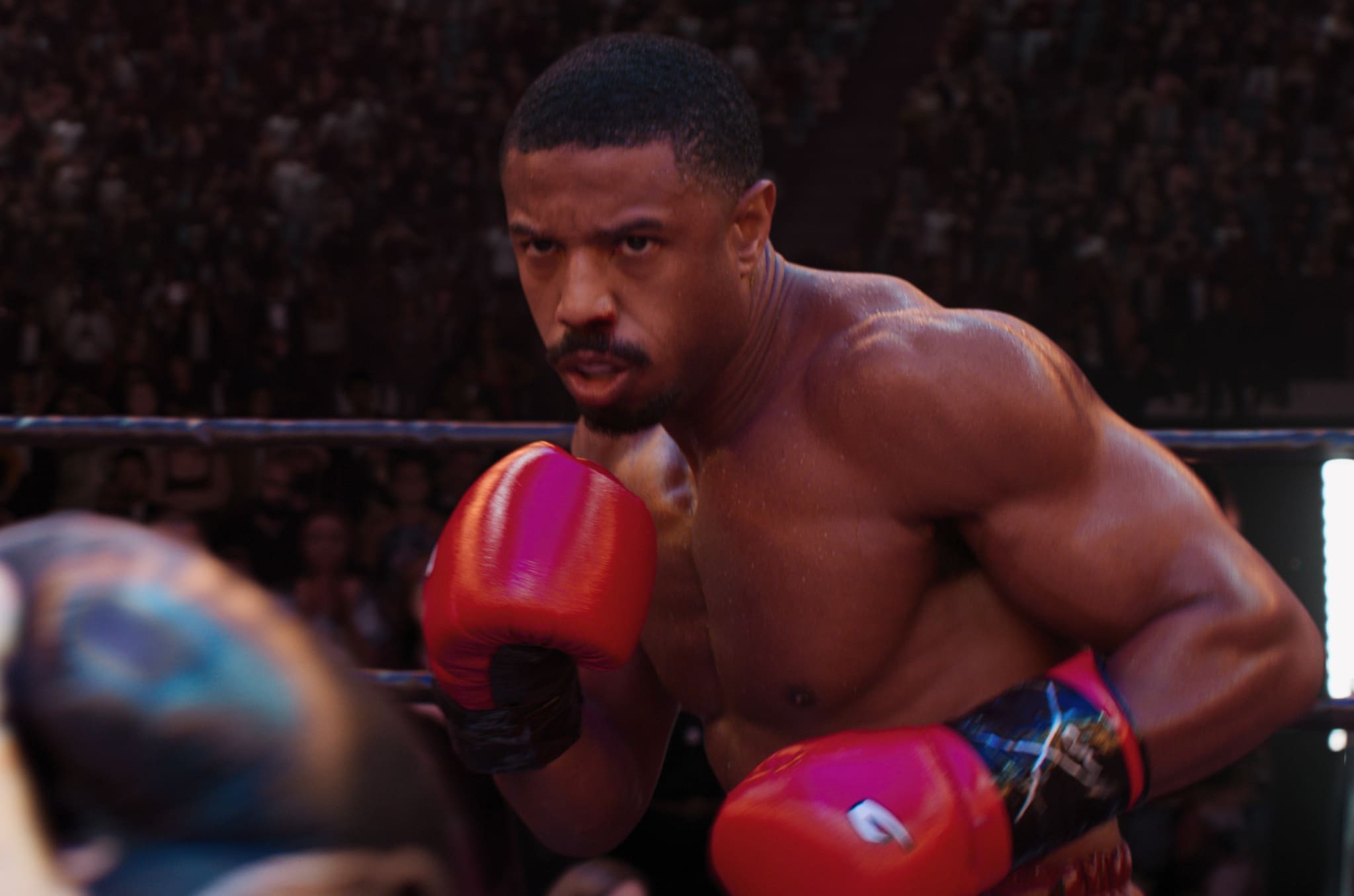
Creed III marks the first time Michael B. Jordan sits in the director’s chair. The actor has decades of experience on a set thanks to being a child star in movies like Hardball and shows like The Wire. It was only natural that he was bound to pick up a few tricks along the way, and the curiosity to one day be behind the lens. Not only did he have Creed director and longtime collaborator Ryan Coogler on speed dial, but he also had other famed actor-turned-directors in his corner to walk him through the process like Denzel Washington, Jon Favreau, and Bradley Cooper.
Jordan has lived in the Creedverse, as he calls it, for eight years. The first film dropped in November 2015, but he worked hand-in-hand with Coogler and Sylvester Stallone to craft the story. Now at the reins, Jordan had full control of where he wanted to take it. His choice to focus on his character Adonis Creed’s backstory was not one Stallone agreed with. It was reported that the actor wouldn’t be reprising his role as Rocky Balboa as he had in the first two films because the story had gone down in a different direction than he would have liked. “What it was is Michael is telling a story, highly personal, but there’s no room for me,” he told The Independent. “In other words, it’s about his [Adonis’] family, about his dilemma, and about his journey that has nothing to do with boxing.”
While Stallone was incredible for connecting the originals to the first two Creed installments, Creed III is so thoroughly packed with so much tension, emotion, and excitement that it’s easy to forget Stallone’s absence. When Jordan is asked if he felt any apprehension about adding this story and these emotions to a sports film, he confidently shrugs it off, saying there was never any doubt in his mind. “Not even a little bit. I thought it was natural. I didn’t think about that at all actually,” Jordan tells Complex. “It just felt like it was a natural evolution of the story and the character and that’s what we went with.”
Jordan has made this film fully his own, even while sharing the screen with another giant—Jonathan Majors, who plays his childhood friend, Damian. The film focuses primarily on the power of brotherhood and the friendship between these two men. Jordan laughs when I tell him that I find male friendships interesting to examine, but it’s true. Not to be stereotypical, but friendships between men seem to be a lot more easygoing and forgiving than friendships between women at times. But Damian and Adonis’ friendship is much more complicated than that because of what they endured together as kids as part of the foster care system and everything that has happened to them since.
When they reunite after Dame returns home from prison, the characters do a delicate dance between familiarity and finding out who each other has become because of the circumstances they faced in the last 18 years. They may inspire negative feelings in each other as adults, but deep down they continue to be the two hurt boys who were dealt an unfortunate hand and now have to find their way out of those emotions.
“It’s a brotherhood. Brotherhoods are complex and layered and beautiful and we wanted to really dive into that brotherly love,” Jordan says about exploring their history. “Sometimes there’s space between the masculinity and the toxic masculinity and what’s OK to apologize for or atone doesn’t make you weak or lesser than a man, but it actually makes you stronger to admit your faults and say, ‘I’m sorry,’ and say, ‘I love you.’ That’s OK.”
“We represent two sides of a conversation and also in a lot of gray areas and how you can come back together again,” he continues. “I thought it was a beautiful brother story.” While the love between the characters might still be real 18 years later, there is still a level of animosity and anger, especially coming from Damian. While Adonis is living in a mansion in Los Angeles with his wife and daughter, Damian is running against the clock, trying to accomplish everything he couldn’t while he was behind bars. Adonis was able to triumph because Dame introduced him to the boxing world when they were kids, but also because his last name afforded him the opportunity to get out, which makes him consider whether or not he truly earned his success. This feeling of guilt and impostor syndrome is also something Jordan, who is from Newark, New Jersey, is familiar with in his own life.
“It was just authentic to Adonis’ storyline, the Black experience, and starting out where he started out from being a victim of the system so to speak,” he says. “And then getting that golden ticket and being able to better his situation, his family life and dynamics and all, being called a ‘silver spoon,’ but not really fitting in one place or another. And getting all this attention that he didn’t feel was earned for him. And then him figuring it out and working hard for it.”
Even while staring at the championship belts on his wall, Adonis still finds himself needing to prove himself to Damian. “There’s still that level of unsureness and I think that’s something that I could relate to that I feel like other people that evolve and sometimes outgrow past situations can identify with as well,” the director adds. “So, we felt like it was an honest portrayal of where Adonis was in his career and in his life and we wanted to talk about it.”
So far, people have been reacting well to the different layers and tones in the film. It has humor (Thanks to a hilarious guest appearance by Stephen A. Smith), heart, violence, grief, adrenaline, and triumph; all the wide range of emotions a film of this grandness and magnitude is supposed to make audiences feel. “I’m humbled and honored that people are responding to it the way they are and the fact they’re being moved by it and they get it,” he says. “They get the themes, they get what we were trying to say and how we needed to move. That’s really a great feeling when people understand or understand most of what you were trying to do.”
Now that Adonis is retired, we also see his 9-year-old daughter Amara take interest in boxing—even watching her father’s fights in secret and learning from him. So is there a possibility that we could see Amara stepping into the ring in future Creed films? “Maybe. We don’t know yet. I’m still figuring it out. I’m trying to get finished with this movie, honestly. And get this one out there,” he says with a laugh. “It’s been a long journey.”
While Adonis’ story of perseverance and victory does feel complete with Creed III, Jordan promises that this franchise is far from over. “I feel like the Creedverse is definitely going to expand and grow and it can go a bunch of different ways,” he says. “But you’ll see more of the Creed family in the future. I can say that.”
Creed III is in theaters this Friday.