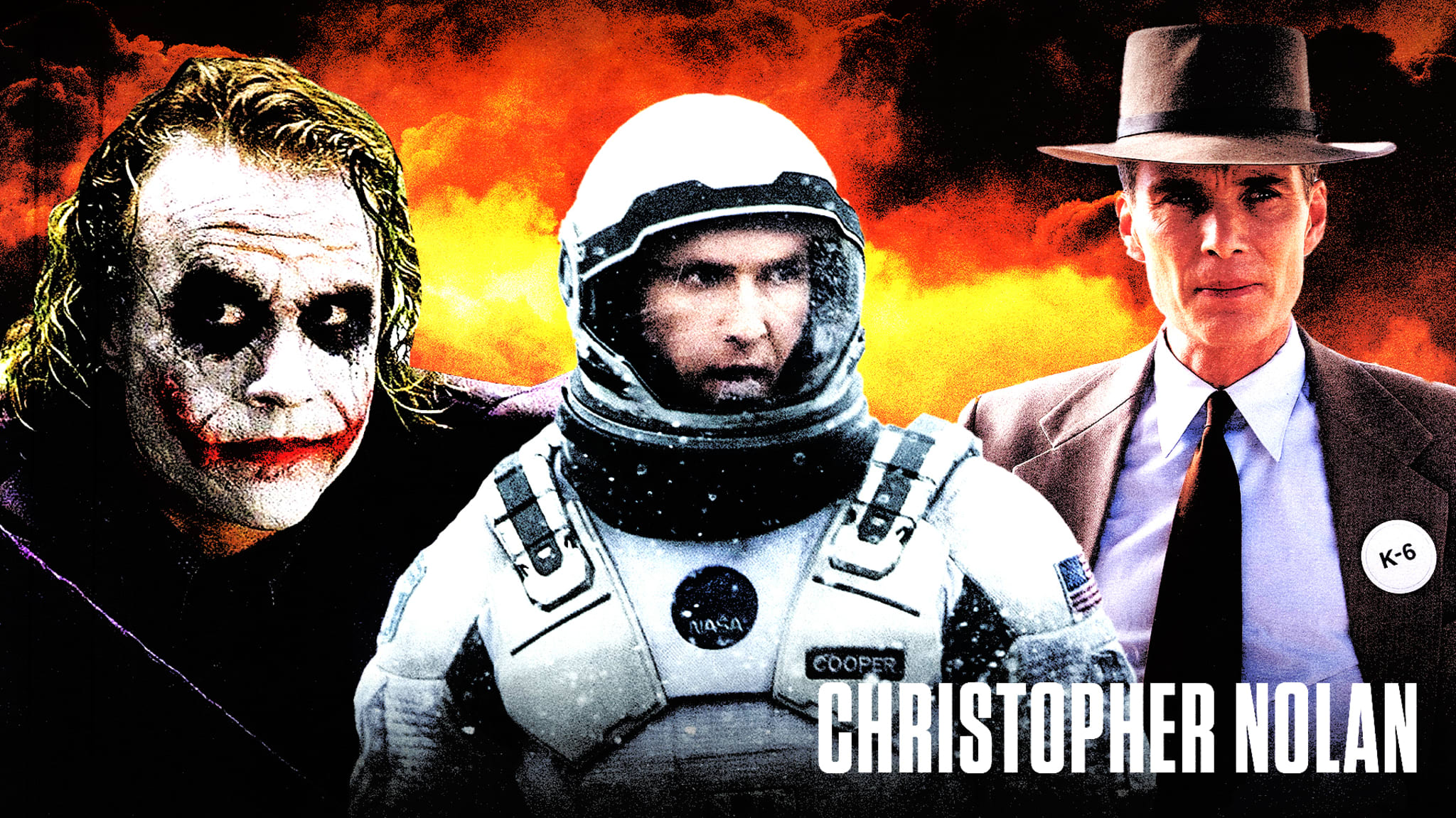
For nearly two decades, Christopher Nolan has done the impossible: write and direct smart, labyrinthine films under big studio banners that both critics and audiences adore. He is, squarely, an outlier. Even when sharp-toothed critics attack, the complaints are almost complimentary. If being too “ambitious” or “grandiose” is your biggest fault, you’re probably doing pretty damn good.
The London-born auteur continues his streak of success with the release of Oppenheimer, a three-hour long tour de force that brings the absolute best out of its actors and proves why Nolan is one of the best in the movie-making business. Filmed in IMAX, Oppenheimer also reinforces why these type of films are made for the big screen as it is equally beautiful as it is brilliant.
With the film’s release, we decided to take a second look at our ranking of Nolan’s entire filmography. Let the debate begin.
(Editor’s note: the ranking has changed since this list was initially published in 2017, and contains light Oppenheimer spoilers).
13.
For nearly two decades, Christopher Nolan has done the impossible: write and direct smart, labyrinthine films under big studio banners that both critics and audiences adore. He is, squarely, an outlier. Even when sharp-toothed critics attack, the complaints are almost complimentary. If being too “ambitious” or “grandiose” is your biggest fault, you’re probably doing pretty damn good.
The London-born auteur continues his streak of success with the release of Oppenheimer, a three-hour long tour de force that brings the absolute best out of its actors and proves why Nolan is one of the best in the movie-making business. Filmed in IMAX, Oppenheimer also reinforces why these type of films are made for the big screen as it is equally beautiful as it is brilliant.
With the film’s release, we decided to take a second look at our ranking of Nolan’s entire filmography. Let the debate begin.
(Editor’s note: the ranking has changed since this list was initially published in 2017, and contains light Oppenheimer spoilers).
12.Following (1998)
Stars: Jeremy Theobald, Lucy Russell
There’s irony in the push and pull of Nolan’s vagueness and specificity in Following. Characters remain nameless. The Young Man (Jeremy Theobald)—lonely and despondent—who fills his days by wandering around the streets of London, “shadowing” strangers. His intentions aren’t nefarious. He’s not bloodthirsty. “This isn’t a sex thing” he tells a therapist. He’s an aspiring writer without material. It’s a rather ingenious beginning for Nolan—a directorial debut about a man who wants to start his career. It wasn’t a smash success upon its release. But in the intervening years, the neo-noir marks the arrival of an unique voice who writes, directs, photographs, and helps edit.
11.Insomnia (2002)
Stars: Al Pacino, Hillary Swank, Robin Williams
There’s not much about Insomnia that feels like the standard Christopher Nolan joint. For some that may be why the grisly thriller is a personal favorite. On the outset, the movie is a fairly open-and-shut case: Al Pacino plays a weathered LA detective shipped to Alaska to solve a murder. A small-town crime that needs a big-city hawkshaw. Nolan spins a morality tale out of the proceedings, as Pacino becomes undone by his unconventional tactics. There’s also Hillary Swank, because this is an early 2000’s drama. It’s not an egregious affair, but it also never elevates beyond being an aggressively competent remake of the 1997 Norwegian thriller. Given what precedes and follows, this is more of a detour than a final destination for Nolan.
10.Memento (2000)
Stars: Guy Pearce, Carrie-Ann Moss
What happened here is not Memento’s fault. As of today, Nolan’s sophomore feature comes in at #48 on IMDB’s top 250 list. Comically—and coincidentally—it’s followed by The Prestige. (You can guess what’s next on this list.) Again, this is all secondary to the art at hand. What’s important here is that Guy Pearce turns in a stirring performance as a grieving widower turned amateur detective who suffers from anterograde amnesia. A man who cannot form new memories. Hopefully in time we’ll be able to form some fresh ones about Memento—a film that deserves to viewed with a fresh set of eyes.
9.The Dark Knight Rises (2012)
Stars: Christian Bale, Tom Hardy, Anne Hathaway, Joseph Gordon-Levitt
The first draft of Nolan’s Batman finale was, reportedly, around 400 pages. For context, the average length of a feature film script is about 120. Numbers are numbers, but The Dark Knight Rises is inexplicably overlong. In an attempt to be a superhero film about contemporary capitalism and moral relativity, it lands in a strange purgatory. It doesn’t help that Nolan wrote (and filmed) somewhere between three and four different endings, before stumbling into a commercial cliffhanger. On repeat viewings, Tom Hardy’s Bane is the only consistent treasure. He’s an unhinged, menacing anti-hero—an effective foil to Christian Bale’s calm and composed Batman.
8.Tenet (2020)
Stars: John David Washington and Robert Pattinson
Christopher Nolan’s fascination with time is well-documented at this point. He loves a non-linear plot, it’s a device that he uses often. And there is no greater example of it than in the release of 2020’s Tenet. There is no doubt that Nolan took a bounty of bold swings with the film's direction, but I’d argue that a lot of those swings were misses, creating an incredibly convoluted and confusing story.
I’ve seen the film at least four times now and I’m still not certain I know what went on in it. That being said, there are plenty of redeeming qualities in the film: it is undeniably a Nolan movie, from its rampant pacing, its expensive set pieces, and its plethora of homages to the work of his past. Known for his opening scenes, Tenet has got to be one of Nolan’s strongest, setting to tone for a high-paced ride that really never slows down, for better or worse.
7.Batman Begins (2005)
Stars: Christian Bale, Michael Caine, Liam Neeson, Cillian Murphy
Origin stories-wise, this is damn near as good as we’ve received. Nolan was quick to set a precedent here. His vision of Gotham was not going to be watered-down or PG. If he was hired to direct a trilogy, he was going to do it his way—for better or worse. Warner Bros. allowed the filmmaker to bring in the talent he wanted.
Trained, serious dramatic talents who we were unaccustomed to seeing in a superhero movie—Michael Caine, Morgan Freeman, Liam Neeson, Cillian Murphy, the list goes on. If there’s one reservation it’s that the special effects at the tail end of Batman Begins don’t especially hold up in 2017. (That final train action sequence between Neeson and Bale doesn’t quite look right.) Still, Nolan shattered preconceptions of what a film of this nature could do or be. It was not bound by virtue. Darkness could be let in.
6.Interstellar (2014)
Stars: Matthew McConaughey, Anne Hathaway, Jessica Chastain
If there’s one thing Nolan seems to routinely struggle with it’s romance. Matters of the heart are too messy and idiosyncratic for the left-brained craftsman. This is where Interstellar collapses. Forget its bloated nature, the intergalactic travel, the backstabbing, Matt Damon. It attempts, albeit nobly, to make the case that love is the great connector—the ineffable sensation that binds us together as people. It’s an intellectually ambitious pursuit. Perfectly reasonable in nature, but Nolan pins these rose-colored concepts on Anne Hathaway. The veteran actress looks to be visibly uncomfortable in just about every interaction in the film. Out of place and lost—as if she only kinda believes the dialogue she’s been given to perform.
There’s an overriding feeling of wishy-washiness throughout Interstellar. It’s no surprise that the film in fact was not even intended for Nolan to direct. Steven Spielberg signed onto the project in 2006. He subsequently hired Jonathan Nolan, Chris’ brother and frequent collaborator, to pen the screenplay. Spielberg would eventually go on to hand the reigns over to Nolan years laters. It’s just hard to not imagine how this project would have unfolded with Spielberg at the helm.
5.The Prestige (2006)
Stars: Hugh Jackman, Christian Bale, Rebecca Hall, Scarlett Johansson
What’s exciting about The Prestige is that it’s the first instance in which Nolan looks to be truly comfortable with his directorial voice. It’s the equivalent of an athlete recognizing the onset of his/her prime. Nolan flexes his muscles here without showing off. He reduces the unfocused quick cuts, leans into Wally Pfister’s sumptuous work as DP, and lets Hugh Jackman and Christian Bale trade fours at the height of their stardom.
Adapting from Christopher Priest’s novel, it manages to narrowly avoid being gimmicky or cheap. It sets a clear dramatic stage: two ambitious magicians drive each other mad as they push their passion (and profession) to the extreme. The Prestige is a true rarity in that it’s just as clever as it thinks it is. And then some.
4.Dunkirk (2017)
Stars: Fionn Whitehead, Tom Hardy, Harry Styles
Nolan drops the subterfuge with Dunkirk: the post-production trickery, the mind-bending world-building, the bombast. Next to Insomnia, it’s the least Christopher Nolan film Christopher Nolan has ever directed. Clocking in at 104 minutes (less than two hours!) it tells the real story of 400,000 soldiers stranded in the eponymous city. As the German army approaches, the Allies (Belgium, the British Empire, France) must rally together to survive. Death appears to be imminent. The calvary doesn’t look to be coming, as the Nazis continue enveloping the Allies in their web.
Beyond its technical achievements (see: Hans Zimmer’s rousing score, the aerial combat between fighter pilots) Nolan has made a deeply human journey about the truth of war. How it simultaneously takes no prisoners in its relentlessness, and yet makes everyone one; how even the most just battle between opposing civilizations is unjust in nature; how we allow young men and women to cut their lives short in the name of politics. There’s no true triumph to be had here. The proceedings are appropriately sobering and bleak—a clear-eyed snapshot of how fear moves everything around us, then and now.
3.Inception (2010)
Stars: Leonardo DiCaprio, Marion Cotillard, Ellen Page, Joseph Gordon-Levitt
Look, so long as we’re not calling Inception one of the best films ever made, we’ll be okay. People are reluctant to put it on the “Greatest Cinema Ever Made” mantle. This is completely fair. But let’s look at Inception for what it is: an awe-inspiring technical achievement in storytelling. In 2017, the dreams within dreams conceit has become a punchline, but it wasn’t always. If you can buy into Nolan’s gobsmacking dreamscape then the spinning top works. What’s beneath the surface is equally engaging, though. It’s a moving portrait of a widower (Leonardo DiCaprio) trying to reconcile with the loss of his late wife (Marion Cotillard).
This is the rare instance where Nolan seems to understand the complexities of love—the inherent messiness of entangling yourself with another human being. And yet Nolan doesn’t simply understand these ideas, he's unafraid of them. The vision is bold and uncompromising. Whether you adore or despise, Inception finds its craftsman fearlessly wading into the unknown, ready for whatever is to come.
2.Oppenheimer (2023)
Stars: Cillian Murphy, Robert Downey Jr., Matt Damon, Emily Blunt.
It’s hard not to leave the theater after seeing Oppenheimer without an existential sense of dread. Masterfully written and directed, the film leaves you with a feeling that the world can be on the brink of catastrophic war at the drop of a hat. Nolan spends three hours telling the story of J. Robert Oppenheimer (played by Cillian Murphy), one of the most polarizing people in American history, in the first person point of view. In an exclusive interview with Complex, Emily Blunt describes Murphy’s performance as equally delicate and beautiful—and she's right.
Oppenheimer is not disturbing in the traditional sense of the word. There isn’t really any violence, and you don’t see the detonations over Nagasaki and Hiroshima. But you see the physical acting of Murphy’s Oppenheimer, you see the morality that he constantly struggles with being responsible for the invention of the deadliest weapon in human history. His crystal-blue eyes pierce you every moment he’s on screen, cementing what is bound to be an Academy Award nominee-worthy performance.
Robert Downey Jr., Matt Damon, Blunt, and a never-ending cast of familiar faces come together to tell a story that will almost certainly clean up during Oscars season. An argument can certainly be made that the final hour is the best hour of film-making that we’ve seen from Nolan, the pacing and tension that he’s able to create while switching between multiple timelines and trials will have you on the edge of your seat until the credits roll in.
Murphy says that Oppenheimer might be Nolan’s Magnum Opus, and while we’re not quite ready to claim that it’s better than The Dark Knight, it can and should certainly be talked about in the same breath.
1.The Dark Knight (2008)
Stars: Christian Bale, Heath Ledger, Aaron Eckhart, Maggie Gyllenhaal
It’s hard to watch The Dark Knight today and not feel the specter of Heath Ledger looming. The late talent was only getting started, approaching the peak of his powers when Nolan casted him as the villainous Joker. The performance—and the film—have since become anointed. Is it the best superhero film made to date? Probably. But that’s kinda like calling Rand Paul the best Republican in the Senate. It may be true but it’s a super low-bar. Nolan’s second installment in Gotham is far-and-away his strongest. The city feels alive and inhabited. It avoids getting bogged down in needless subplots. Most of all, it’s bolstered by Ledger’s decade-defining performance. With each scene he creates nihilistic poetry. There’s no rhyme or reasons to his crime—which makes it all the more unnerving.