Image via Complex Original
Fake sneakers have been around for what feels like forever. Entrepreneurial bootleggers have tried their hand at reproducing the most popular shoes in the hopes of deceiving naive consumers and making a quick buck. Clear Air Jordans, ones with suspect Jumpman logos, and pairs that come in every shade of the rainbow have long been the lasting image of what constitutes a fake sneaker. The crinkly leather, misprinted box tags, and suspicious smell are what crosses people’s minds when we speak of fake footwear. But there’s also another sort of bootleg sneakers: The ones made with the intention to take elements from a brand’s well-known designs and mold them into something different. We’ve seen this recently with the fiasco surrounding Nike’s legal pursuit of Warren Lotas’ Dunk-esque sneakers. but it also goes back to Nigo’s work on A Bathing Ape’s Bapesta, copycat Air Jordan 1s, and more. Here’s a quick history lesson.
Sang Jordan 1
Inspired by: Air Jordan 1
Year: 1985
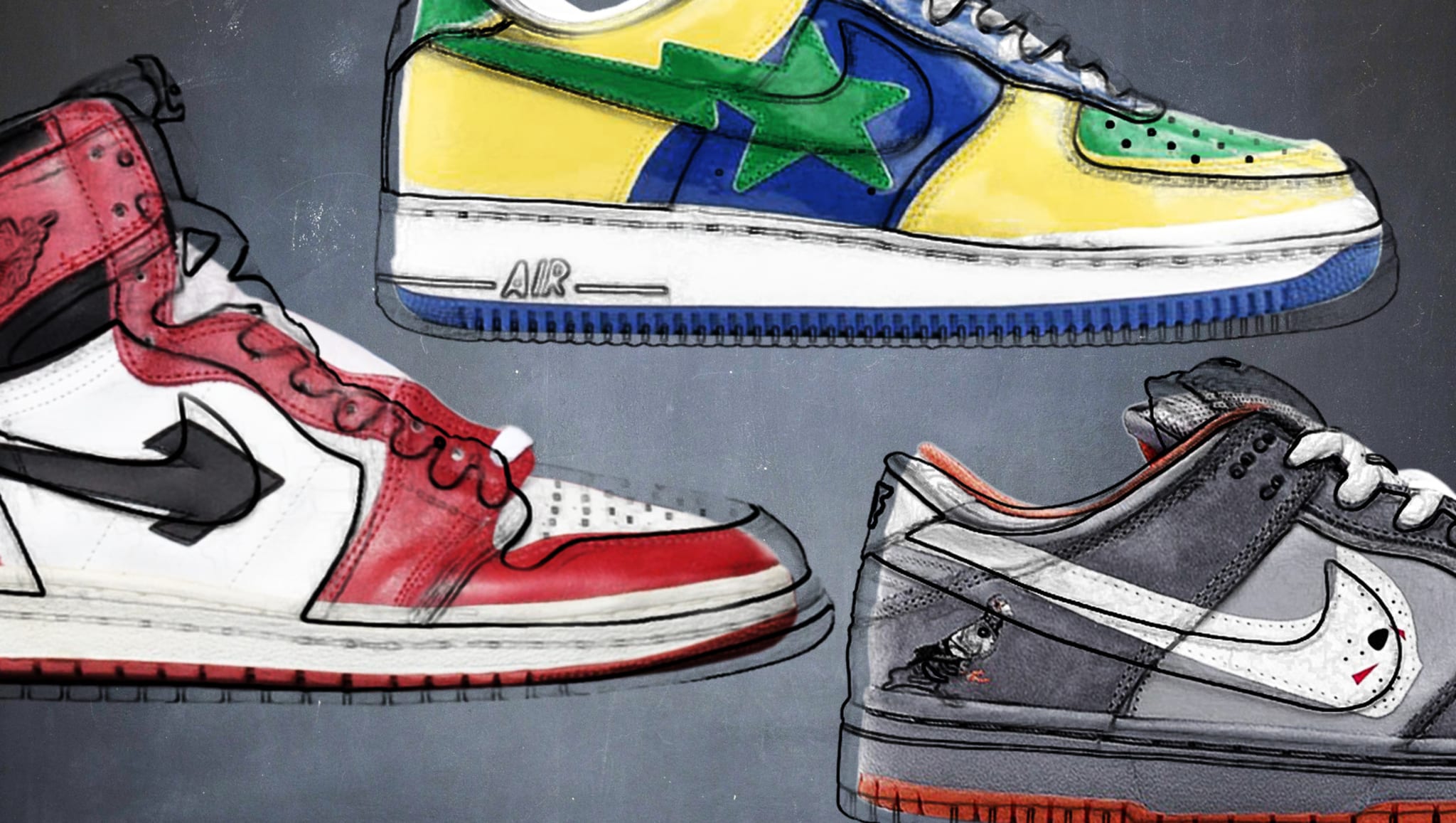
It’s not completely clear when the first bootleg sneaker was created, but of the first ones that mattered and left a lasting impression is Sang’s copy of the Air Jordan 1 from 1985. The sneaker copies the “Chicago” Air Jordan 1, but its Swoosh is replaced by an arrow-style logo. The sneakers, which were made in Korea, were not what you’d consider a bootleg that attempted to subvert a well-known model for underground cool. They’re simply a reproduction of the Air Jordan 1 under another brand’s name, which then replaced the logos. Not much is known about the shoe, but it wasn’t the only shoe to knockoff the Air Jordan 1 in the 1980s. The XJ-9000 was another model that copied the Air Jordan 1. Pairs of the Sang Jordan 1 have sold for upwards of $3,800, placing it far below what a deadstock pair of Air Jordan 1s would go for (in the ballpark of $15,000), but they are nevertheless an artifact. —Matt Welty
A Bathing Ape Bapesta
Inspired by: Nike Air Force 1
Year: 2002
Nigo’s A Bathing Ape brand had been around for nearly a decade before striking gold with the Bapesta sneaker in 2002. An obvious reference to the Air Force 1, the Bapesta was unique in that it came in colors and materials that Nike simply wasn’t offering at the time. Think candy paint-like patent leather in bubblegum pastels and camouflage patterns. The change of pace was welcome among sneaker enthusiasts, who had grown fatigued over the simplistic, mostly two-toned Air Force 1s Nike was producing. According to Ari Saal Forman (whose Ari Menthol 10s are also featured on this list), Bapestas cost Nigo’s brand just $2.25 to make in the early 2000s. Stateside, they would retail for nearly $200 after tax, and that’s only if you could track down a pair. Along with the shoe’s stand-out color combinations, part of the Bapesta’s allure was its exclusivity, with only a handful of U.S. stores stocking authentic pairs. The shoe would go on to get collaborations with a young Kanye West, Pharrell’s N.E.R.D., electronic duo Daft Punk, and pop culture projects with brands like Marvel Comics. —Riley Jones
Reebok S Dot Carter
Inspired by: Gucci Tennis '84
Year: 2003
Jay-Z made a generation of rappers and fans wear their Nike Air Force 1 just once before tossing them away. But his most memorable footwear moment has nothing to do with the Air Force 1 or a sneaker he name-checked in a lyric, it’s his partnership with Reebok that launched on April 13, 2003, with the introduction of the S Dot Carter sneaker. The shoe was something we had never seen before, even if its roots traced back to the Gucci Tennis 84, a hustler’s shoe that has a storied place in sneakers and hip-hop: A rapper was able to sell 10,000 pairs of shoes in just a few hours. In an era before bots and resellers, nothing like that had been seen, save for an Air Jordan. Jay-Z was in rarified air. He didn’t hide the inspiration for the sneakers, instead he boasted about it in a Reebok commercial. “Got the sole of the old Guccis, if you upset, sue me,” he rapped. Gucci never went after Jay-Z or Reebok for these sneakers. But the white shoes, with green and red accents, will forever remain a piece of footwear lore. —Matt Welty
Ari Menthol 10
Inspired by: Nike Air Force 1
Year: 2006
Dedicated to the "the two brands that have taken the most and given the least," this 2006 design by artist Ari Forman imagined a collaboration between Nike and Newport cigarettes. The silhouette took the recognizable Air Force 1 and flipped its Swoosh to look like the spinnaker logo used on Menthol cigarette packs. The shoes were sold at two stores only, Clientele and Alife, with some coming in jumbo cigarette-box-inspired packaging. Nike sent Forman a cease and desist. Lorillard, the holding company of Newport, went further with a lawsuit that eventually ended in a strict settlement. Forman said he lost $50,000 on the ordeal and wasn't legally allowed to own the shoes, or even a picture of them, afterward. He wasn't able to talk about them for years either, but has lately been more open about the fiasco. The Ari Menthol 10s have become increasingly more sought after by collections in recent years, with prices for them on the secondary market running into the thousands of dollars. —Mike DeStefano
Consolidated BS Drunks
Inspired by: Nike SB Dunk High "Send Help"
Year: 2006
Nike SB wasn’t always the biggest footwear name in the skateboarding industry. In fact, there was an era where it was viewed as a laughing stock. In the late ‘90s, Nike tried to break into skating, but its status as a big athletic brand and awful shoes with names like “Choad” halted it from any success. Skate brands were staunchly against the footwear behemoth dipping its toes in their waters. One of those brands was Consolidated, which didn’t make shoes, but had been against Nike getting into the game since 1997. In 2006, it released a shoe called the “BS Drunks” that replaced the Swoosh with a banana and came complete with campaigns that said “Don’t Do It.” It was a backlash to Nike recruiting Consolidated designer Todd Bratrud to design a Consolidated-themed Dunk for Nike, which ended up being the “Send Helps.” Consolidated caught wind and replied with the BS Drunks, which kept the same colorway of the shoe. The brand sold 2,600 pairs of the sneakers and was able to escape the fiasco free from any Nike litigation. —Matt Welty
Mike23 Chuck Taylors
Inspired by: Converse Chuck Taylor and Air Jordan 3
Year: 2007
Mike23 took the vibe of mid-2000s streetwear—elements like logo flips, graphic tees, and all-over prints—and put it in an even more sneakerhead-friendly-than-normal Air Jordan-themed package. Given the times, it’s not surprising that its elephant print-covered Chuck Taylor copies, complete with “Mike” on the heel bumper in the Nike font, were perfectly acceptable to wear while snapping a “sneaker circle” photo with friends. The brand was further legitimized by landing in respected and influential boutiques like Paris’ Collette, capitalizing on a burgeoning apparel market the big brands had yet to capture. That success caught Nike’s attention, and they were promptly slapped with a cease-and-desist order. As a result of the ensuing settlement, Mike23 was forced to shut down, but according to a former employee, old product is still sitting in a warehouse 12 years after its 2008 closure. —Zac Dubasik
Gourmet "Cease" and "Desist"
Inspired by: Air Jordans
Year: 2008
Founded by Jon Buscemi, Greg Johnsen, and Greg Lucci in 2005, Gourmet’s footwear was essentially a more sophisticated version of sneakers from brands like Greedy Genius that knocked off popular Air Jordans and Nikes. The former was Gourmet’s specialty, with silhouettes that ripped cues from the Air Jordan 7, Air Jordan 11, Air Jordan 12, and Air Jordan 13. The shoes were given tongue-in-cheek names like “Cease” and “Desisto,” which ultimately were foreshadowing of the brand’s future. Gourmet went a little too hard with its Nike knock-offs, and before long, the Swoosh came knocking with a federal lawsuit. Gourmet put up a brief fight in court, but the brand eventually agreed to stop selling the offending shoes and folded shortly thereafter. In 2013, Buscemi found new success after launching his own namesake brand, which most famously makes sneakers inspired by the iconic Hermès Birkin bag. The Buscemi brand is still putting out Italian-made shoes, while Gourmet lives on mostly only in Google image searches. —Riley Jones
Rick Owens Dunk
Inspired by: Nike Dunk
Year: 2008
This high-end riff on the Nike Dunk, designed (and discontinued) in 2008, is quintessential Rick Owens. It features exaggerated proportions, heirloom-quality materials, and a grunge-meets-goth-meets-ninja aesthetic that’s overtly casual yet clearly the most expensive pair of shoes in the room. That’s a lot more than most bootlegs can say when it comes to validating their existence, but, unfortunately for the avant garde designer, it wasn’t enough to win Nike’s seal of approval. Owens took it in stride though, telling Complex in a 2015 interview that he “swooned with flattery when Nike sent me a cease and desist.” Following the threat of a lawsuit, the sneaker was redesigned with a new Swooshless upper, and dropped the “Dunk” nickname in lieu of its proper “Geobasket” moniker. Despite the early issues, it’s still available today with a retail price starting over $1,000—and only goes up from there, dependent on the cut and materials. —Zac Dubasik
Hender Scheme MIP-10
Inspired by: Air Jordan 4
Year: 2014
When is an Air Jordan not an Air Jordan? Hender Scheme answered that question in 2014 with this sneaker that was stripped of the Air Jordan 4's signature technology and branding. A part of the Japanese brand's Manual Industrial Projects line, the shoe rebuilt the Air Jordan 4 from the ground up with natural leather and a thick, sturdy sole. The Hender Schemes elevated their sportswear muses through material selection, their raw leathers shifting color and wearing a patina with age. None of Hender Scheme's MIP sneakers—which also included homages to the Adidas Superstar and New Balance 1300—have ever been the subject of legal action from the sportswear companies they borrow from. In fact, Adidas eventually collaborated with Hender Scheme on sneakers like the NMD and the Superstar. Those partnership pairs didn't generate the same excitement as Hender Scheme's own shoes, but marked a rare moment where the imitator and the imitated worked with each other rather than against each other. —Michael DeStefano
Warren Lotas x Staple Pigeon OG
Inspired by: Staple x Nike SB Dunk Low "Pigeon"
Year: 2020
When Los Angeles-based designer Warren Lotas first put a hockey mask on a pair of Nike Dunks, it was merely a rendering on a computer screen. From there, he decided to start selling them, releasing the first batch in November 2019 for a pre-order that took months to fulfill. While the sneakers closely mimic the Nike SB Dunk, they are not actual Nike products. There was a pair referencing a 2006 Jason Voorhees-esque colorway, another done to look like the Stussy x Nike SB Dunk Low, and one resembling the rare "Heineken" SB Dunk Low. Lotas kept it going until September 2020 with this audacious pair, an official Jeff Staple collaboration referencing the classic "Pigeon" SB Dunk from 2005. By then, Nike had had enough. The sportswear company sued him in October, accusing him of selling "illegal fakes" of its designs. Lotas countersued, saying Nike's trademarks around the Dunks were invalid. The lawsuit is ongoing. — Brendan Dunne