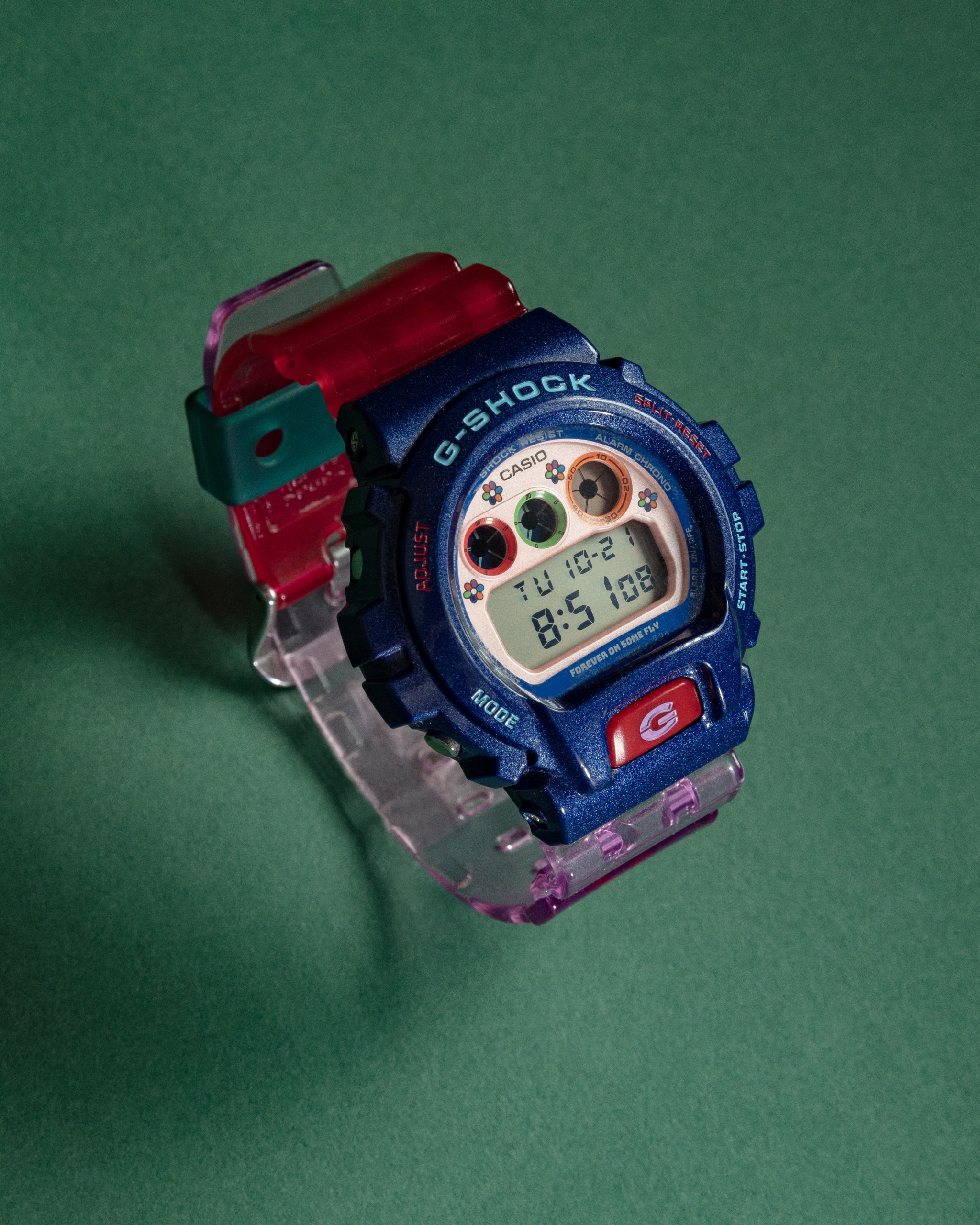
Casio’s G-Shock was born in the 1980s from a quest to build an “unbreakable” watch. Combining rugged utility with affordability, it evolved from a niche Japanese innovation into a global icon embraced by streetwear aficionados, hip-hop artists, extreme sports athletes, and soldiers alike. Over four decades later, the G-Shock is still one of the most celebrated watches on the market.
The 1980s: Born to Survive
In 1981, Casio engineer Kikuo Ibe set out to create a watch that could endure the harshest treatment. He formed “Team Tough” with a bold “Triple 10” goal: a watch that could survive a 10-meter drop, have 10-bar (100m) water resistance, and a 10-year battery life. After testing over 200 prototypes, Casio released the first G-Shock, the DW-5000C, in April 1983. It was a chunky digital watch with 200m water resistance and unmatched shock resistance.
A U.S. TV commercial from 1984 ignited its popularity in the market. In the ad, the DW-5200 G-Shock was used as a hockey puck to demonstrate its unbreakable durability. By the late 1980s, G-Shock had caught on with police, firefighters, and the military. In 1989, Casio expanded the line with the release of the AW-500, the first analog-digital G-Shock.
The 1990s: Introduction to Youth Culture
The 1990s transformed G-Shock from a utilitarian tool into a streetwear statement. Skaters, surfers, and hip-hop artists adopted G-Shocks as part of their style. The chunky form became a staple on the wrists of those driving youth culture.
Casio kept the momentum going with specialty models like the “Master of G” series, which included the Frogman (1993) for divers and the Mudman (1995) for off-road use. The Baby-G line, launched in 1994, targeted women with smaller, more colorful variants. That same year, Keanu Reeves wore a DW-5600C in Speed, cementing the timepiece’s pop culture prominence.
The 2000s and 2010s: Innovation and Expansion
In the 2000s, G-Shock continued to advance technologically with the addition of solar panels, radio signal synced atomic timekeeping, compasses, and thermometers.
G-Shocks also became increasingly stylish with analog-digital hybrid designs, full-metal versions, and sleeker silhouettes. In 2019, the GA-2100, nicknamed the “Casioak”, became a breakout hit, combining G-Shock toughness with a slim, octagonal design reminiscent of luxury watches.
Throughout the 21st century, G-Shock became a staple accessory for cultural icons. On the September 2007 cover of Complex, Ye sported a hot pink model and Pharrell got his iced out by Jacob the Jeweler. The brand also collaborated with artists such as the Wu-Tang Clan, A$AP Ferg, and Kid Cudi on limited-edition releases, further solidifying its place in streetwear.
Streetwear Collaborations
G-Shock has released countless collaborations over the years. The first came in 1997 with Stussy on the DW-6900. A year later, G-Shock teamed up with BAPE, a partnership that continues today. These collabs helped establish the brand as a canvas for streetwear’s most influential voices. This is a legacy that has continued with brands like Kith and Supreme.
One of the latest designers to collaborate on the iconic watch is Jae Tips. He brought his vibrant aesthetic to the DW6900JT25-2, which sold out at ComplexCon last month. Inspired by the iconic “Triple Graph” layout of the 6900 series, the collab incorporates Jae Tips’ signature flower motifs and bold color palette within a classic G-Shock body. The latest G-Shock x Jae Tips collaboration will restock on Complex on Nov. 7.